

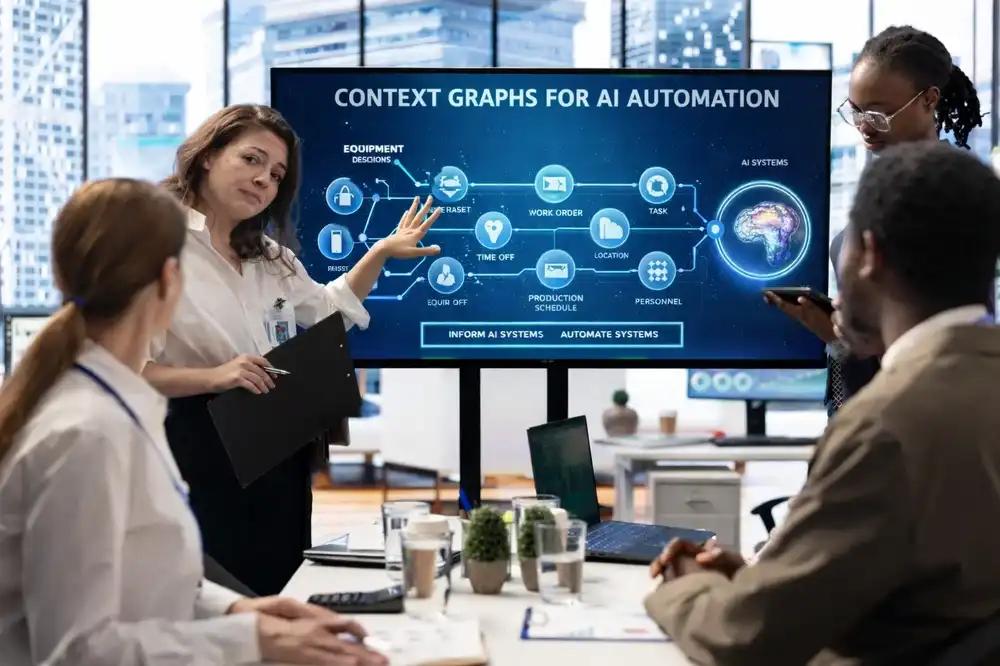
AI has made massive progress in reasoning, tool use, and language understanding. Yet enterprise automation still breaks down when AI tries to perform multi-step, multi-week processes that cut across tools and teams. The missing layer is simple: AI doesn’t know how a company actually works. It only knows what exists.
At Intellectyx AI, we believe the future of enterprise AI depends on solving this gap. Which is why context graphs have become one of the most important building blocks for autonomous, long-running AI agents.
This article breaks down what context graphs are, why they matter, and how a modern enterprise should approach building them.
What exactly is a context graph?
A context graph is a living model of how work gets done inside your company. It connects enterprise entities like people, documents, systems and workflows with the actual traces of activity that link them.
Think of it as the difference between:
Knowing the objects - Customers, tickets, dashboards, docs, Slack channels.
Knowing the behavior - Who did what, when, in which tool, in what sequence, and what outcome it produced.
A context graph captures this behavior in a structured way using two components:
- Nodes: Actions such as created, reviewed, escalated, approved, resolved with timestamps and metadata
- Edges: Causal or correlated relationships between steps that show how processes unfold in reality
This lets AI answer questions that go far beyond search:
- How does a P1 incident usually get resolved here
- What typically happens between onboarding kickoff and onboarding complete
- Why do some deal cycles close faster than others
- How does engineering usually implement a customer escalation
In other words, the context graph tells the AI what the next most probable step is, instead of expecting humans to hard-code workflows. This layer of contextual intelligence in AI orchestration allows systems to adapt dynamically to changing inputs, dependencies, and business rules—ensuring that workflows evolve in real time rather than remaining fixed and reactive.
Why businesses need context graphs now
Enterprises use dozens of tools. Workflows live across CRM, tickets, Slack, docs, calendars, emails, spreadsheets, analytics dashboards and custom internal apps. No system of record captures this full journey.
Two realities drive the need for context graphs:
Systems of record capture static states, not real work
A CRM shows the status of a deal. It doesn’t show the messy back-and-forth that actually moved the deal forward.
A ticketing system shows “resolved”. It doesn’t capture the 27 Slack messages, three documents, and two Zoom calls that made it possible.
Human workflows are inconsistent
Even high-value recurring processes like onboarding, sales cycles, deployments or escalations vary between teams and individuals. Traditional automation breaks because reality never follows the ideal flowchart.
Context graphs fix this by learning real behavior across time and surfacing the patterns that matter.
Related Read - Building smarter multi-agent systems - AgnoAI & LangGraph.
How Intellectyx AI builds context graphs
Our approach is based on four layers that feed into one another.
Deep connectors and observability
To understand how work actually happens, the system needs visibility into:
- CRM and ticketing tools
- Documents and wikis
- Chat and emails
- Calendar and meetings
- Code repositories
- Internal applications
We capture both content metadata and activity traces like views, edits, comments, link references, approvals, escalations and transitions.
The challenge is less about volume and more about consistency:
Different tools have inconsistent APIs, fragmented identities, and unpredictable structures. Building a robust ingestion layer is critical.
A unified knowledge graph
Once raw data is indexed, we run ML pipelines to recognize entities such as:
- Projects
- Customers
- Products
- Teams
- People
- Assets
We also match relationships between them. For example, understanding that “ACME” in a CRM, a support ticket, and a design doc are all the same entity.
Activity signals then allow the system to identify which pieces of information belong to which project, customer, or workstream. This creates a unified view with high confidence.
Knowledge graphs make activity meaningful instead of noisy.
Related Read - Enterprise Strategies for Multi-Environment AI Agent Deployment
Personal graphs that model individual work
Parallel to the knowledge graph, we build a personal graph for each user. This represents the natural flow of their work by stitching together:
- Actions
- Timelines
- Documents
- Chats
- Tasks
- Meetings
- Context switches
Then we group these actions into semantically meaningful units of work using:
- Shared titles and links
- Time proximity
- Meeting signals
- Entity relationships
- LLM-based sequence interpretation
The result: coherent tasks and projects. For example, the system might infer that a cluster of edits, Slack messages, and meetings represent “investigating customer escalation”.
This data remains private to each individual unless they explicitly opt in to share anonymized traces.
Ready to Build Autonomous AI Agents for your Business?
Talk to an AI ExpertAggregating personal graphs into a context graph
When we anonymize and analyze personal graphs in aggregate, we can identify repeatable, high-value processes across the organization.
We capture:
- Action type
- Tool family
- Entity IDs
- Derived process tags
- Timing
- Outcomes
We intentionally drop raw content, user identifiers, and sensitive data.
We only treat a pattern as valid if it appears across multiple people and multiple independent traces. This maintains privacy and removes edge-case noise.
The result is a probabilistic model of:
- What steps typically occur
- In what order
- With what branching paths
- What outcomes correlate with which paths
- What causes deviations
This becomes the foundation for AI agents to plan multi-step workflows.
Closing the loop with agent behavior
If agents operate outside the context graph, the system never learns from them. Our approach keeps agent execution inside the graph so every AI action becomes a new trace.
We monitor:
- Tools the agent used
- Order of operations
- Success or failure
- Efficiency
- Relevance and feedback
We then replay alternatives offline to identify better routes.
Over time:
- Good patterns get reinforced
- Anti-patterns get deprioritized
- Agents get smarter
- Processes become dynamic instead of static
This keeps the execution layer and the context layer aligned.
Why this matters for enterprises
Enterprises need AI that can handle long-running processes like:
- Incident response
- Deal cycles
- Proof-of-concepts
- Onboarding
- Feature launches
- Recruitment funnels
- Vendor management
- Procurement flows
These processes span weeks, cross multiple apps, and involve many small decisions.
A context graph gives AI the missing ingredient and an internal model of how your company truly works.
This enables:
- Accurate multi-step automation
- Autonomous agents that follow real process patterns
- Reduced manual instruction overhead
- Faster onboarding of new employees
- Better knowledge transparency
- Lower process drift
Context graphs are the backbone of autonomous enterprise AI. They sit between raw data and the orchestration layer, ensuring agents stay grounded in real-world workflows rather than static instructions.
If you want AI that can actually execute business processes end to end, not just respond to questions, you need a context graph.


![10 Leading Providers for Production-Grade AI Solutions [2026]](https://cdn.sanity.io/images/d7v5jzao/production/47f75d8ffc68c345a672b07452b2bc422c49909d-1000x667.webp)