
Supply chains are the backbone of every enterprise, yet managing them is becoming increasingly complex. Globalization, fluctuating demand, labor shortages, and unpredictable disruptions create operational headaches for senior leaders. According to Gartner 62% of enterprises report inefficiencies due to siloed processes and lack of real-time visibility.
Traditional automation tools often operate in silos, executing pre-defined tasks without understanding the broader supply chain context. This leads to fragmented operations, delayed decisions, and increased operational costs.
Enter multi-agent AI orchestration, a transformative approach where multiple autonomous orchestration frameworks for enterprises collaborate to handle supply chain operations end-to-end. Unlike traditional automation, these agents communicate, plan, and execute tasks across workflows, delivering predictive insights, speed, and scalability.
Discover how enterprise AI solutions can transform your supply chain - Book a free consultation.
What Are Multi-AI Agents and Why They Matter
What Are Multi-AI Agents?
AI agents are specialized digital “workers,” each trained for a particular function: forecasting demand, optimizing logistics, managing inventory, or mitigating supplier risks. Alone, each agent can solve its own task efficiently. When orchestrated together, these agents operate like a highly skilled team sharing insights, learning from outcomes, and continuously improving decisions.
For example, an AI agent handling demand forecasting can feed its insights to another agent managing inventory allocation. Meanwhile, a logistics agent adjusts shipping schedules based on these recommendations, ensuring seamless end-to-end operations.
Why Multi-Agent Orchestration Is a Game-Changer
Most AI implementations fail because they operate in isolation. Multi-agent orchestration ensures:
- Collaboration: Agents communicate in real-time, share insights, and synchronize tasks.
- Predictive Decision-Making: Agents anticipate disruptions and recommend mitigation strategies.
- Scalability: Supports complex, global supply chains seamlessly.
- Human-Centric Oversight: Humans supervise exceptions, while AI handles repetitive complexity.
By orchestrating AI agents, enterprises move from reactive to proactive supply chain management cutting costs, boosting efficiency, and increasing agility.
Also read - Common Failure Points in Multi-Agent Systems
Key Supply Chain Challenges Solved by Multi-Agent AI
1. Inventory Management & Demand Forecasting
Inventory management is one of the most persistent challenges in enterprise supply chains. Overstocking increases carrying costs, while understocking risks lost revenue. Multi-AI agents can analyze historical sales, seasonal trends, promotions, and even external market factors such as competitor activity or weather disruptions to predict demand accurately.
Example: A global retail company implemented AI agents for demand forecasting. Agents identified seasonal spikes two months in advance, reducing stockouts by 35% and excess inventory by 22%. By linking forecasting agents with inventory agents, the enterprise automated restocking, improving warehouse efficiency.
Pro Tip: Combining predictive analytics with agent orchestration allows enterprises to dynamically allocate inventory across warehouses and fulfillment centers, minimizing both overstock and stockouts.
Expansion: AI agents can also monitor SKU-level trends in real time, adjusting forecasts and replenishment automatically. This reduces reliance on slow manual reports and helps enterprises respond instantly to sudden demand shifts, such as flash sales or viral trends.
Is your Enterprise Ready for AI-driven Supply Chain Automation?
Book a FREE Consultation2. Logistics & Route Optimization
Logistics involves countless variables: shipping schedules, transportation modes, traffic conditions, and warehouse availability. Multi-agent AI orchestration ensures that all moving parts work together harmoniously.
Example: An e-commerce company orchestrated multiple AI agents to optimize shipping and delivery. One agent monitored warehouse inventory, another analyzed traffic and delivery routes, and a third managed carrier selection. The result? Delivery times decreased by 25%, while transportation costs fell by 18%.
Expansion: Beyond routing, AI agents can proactively manage returns, reverse logistics, and even packaging optimization. For instance, an agent can suggest bundling shipments to reduce costs or automatically reroute deliveries to avoid weather delays tasks that traditional logistics software cannot handle dynamically.
3. Supplier & Risk Management
Global supply chains are highly exposed to risk. Supplier delays, compliance issues, geopolitical tensions, and natural disasters can halt production and create financial losses. Multi-agent systems continuously monitor suppliers, track compliance, and generate mitigation strategies proactively.
Example: A manufacturing enterprise used AI agents to monitor supplier KPIs and detect early warning signs of potential delays. When a supplier failed to meet quality metrics, agents suggested alternative vendors and rerouted orders before production slowed, reducing downtime by 40%.
Expansion: Agents can also perform financial risk analysis, monitoring supplier liquidity and payment performance, and trigger alerts for potential disruptions. This end-to-end intelligence ensures uninterrupted supply chain continuity.
Expanded Use Cases for Multi-Agent Orchestration
Case Study 1: Global Manufacturing Enterprise
- Challenge: Coordinating production planning, supplier logistics, and distribution across multiple regions.
- Solution: Implemented AI agents for production planning and scheduling, supplier coordination, and transport optimization. Agents communicated and adjusted tasks dynamically.
- Result: Lead times dropped by 30%, on-time delivery improved by 28%, and manual interventions decreased by 45%.
Case Study 2: E-commerce Fulfillment Optimization
- Challenge: Managing high-volume orders during peak seasons.
- Solution: Agents coordinated inventory allocation, order processing, and shipment scheduling autonomously.
- Result: Order fulfillment speed increased by 20–30%, inventory errors decreased, and customer satisfaction improved.
Case Study 3: Pharmaceutical Supply Chain
- Challenge: Handling sensitive products requiring strict temperature control and compliance monitoring.
- Solution: Multi-agent orchestration monitored storage conditions, predicted supply disruptions, and optimized delivery routes.
- Result: Reduced product spoilage by 15% and regulatory compliance risks by 25%.
Case Study 4: Food & Beverage Cold Chain Optimization
- Challenge: Perishable goods require precise temperature management and fast delivery.
- Solution: AI agents continuously monitored refrigeration units, delivery vehicles, and predicted spoilage risk.
Result: Waste reduction of 12–15%, improved freshness delivery, and faster customer response times.
Also Read - AI in Food Supply Chains
Step-by-Step Enterprise AI Agent Orchestration Strategy
- Map Workflows: Identify tasks that are repetitive, time-sensitive, or high-risk.
- Define AI Agent Roles: Assign forecasting, inventory, logistics, and risk agents.
- Establish Orchestration Layer: Central platform for agents to communicate, delegate, and optimize decisions collaboratively.
- Deploy Monitoring Dashboards: Track KPIs in real-time: order accuracy, cost savings, and lead times.
- Set Feedback Loops: Allow agents to learn from outcomes and continuously improve performance.
- Scale Globally: Extend orchestration to multiple regions while maintaining local flexibility.
- Integrate Human Oversight: Ensure exceptions and critical decisions involve human validation.
Checklist Template:
- Workflow mapping complete
- AI agent roles defined
- Orchestration platform deployed
- KPIs established
- Feedback loops integrated
- Scalable deployment plan ready
- Human oversight protocols defined
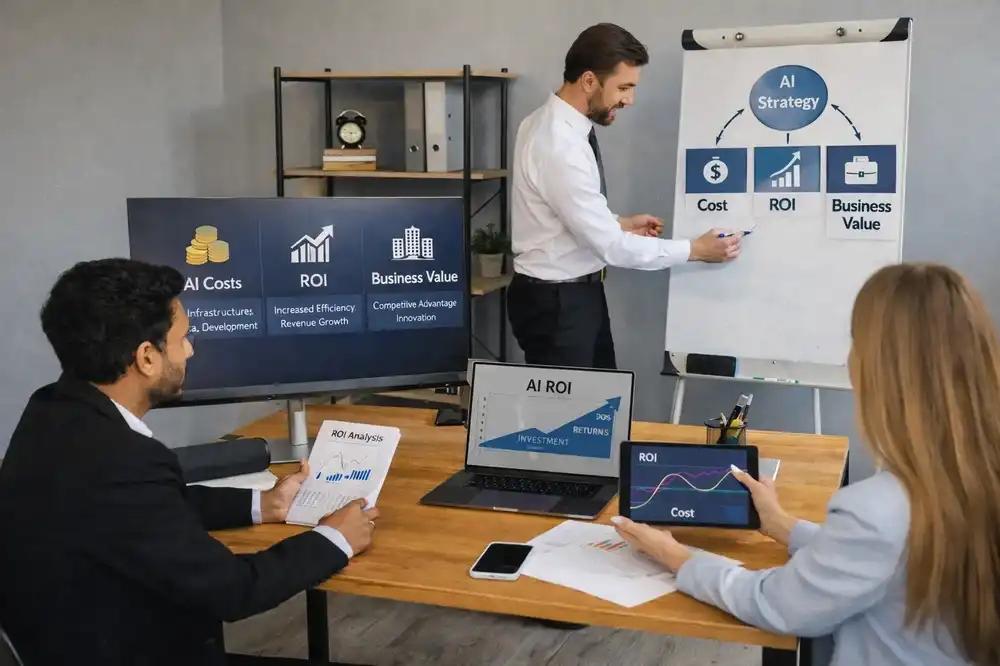
Ultimately, a structured orchestration strategy ensures that AI agents move from isolated pilots to enterprise-wide value creation. Just as important is calculating ROI for enterprise AI deployments, enabling leadership teams to quantify impact, optimize investments, and scale with confidence.
KPIs & Metrics to Measure Success
- Order Accuracy & Fulfillment Rate
- Lead Time Reduction
- Inventory Carrying Cost Savings
- Forecast Accuracy Improvement
- Supplier Risk Mitigation Effectiveness
- Operational Cost Savings
- Customer Satisfaction Scores
Tip: Real-time dashboards allow executives to visualize agent performance while freeing teams from micro-managing tasks.
Want to Build a Resilient and Predictive Supply Chain with AI?
Get a custom AI roadmapWhy Choose Enterprise AI Solutions for Multi-Agent Orchestration
- Faster ROI: Reduces errors, speeds up operations, and lowers operational costs.
- Predictive Insights: Forecasts demand, detects risks, and suggests mitigations proactively.
- Scalable Deployment: Works seamlessly across multiple geographies.
- Human-in-the-Loop: Humans retain control for critical decisions while AI manages complexity.
- Resilience & Agility: Multiple agents operating together can detect disruptions early, enabling proactive recovery and continuous operations.
Connect with our AI experts to explore enterprise-grade supply chain automation solutions.
Conclusion: Orchestrating the Future of Enterprise Supply Chains
Modern supply chains can no longer rely on fragmented systems and reactive automation. As complexity and volatility increase, enterprises need intelligent, coordinated solutions that operate across the entire supply chain.
Multi-agent AI orchestration transforms supply chains from siloed operations into connected, predictive, and adaptive ecosystems. By enabling AI agents to collaborate across forecasting, inventory, logistics, and Agentic ai in supplier negotiation management, enterprises gain real-time visibility, faster decision-making, reduced risk, and measurable cost efficiency. Enterprises that adopt orchestrated AI agents are not just automating tasks, they are building resilient, self-optimizing supply chains designed for scale and continuous improvement.
Ready to modernize your supply chain with enterprise-grade AI agents? Connect with our experts to explore how multi-agent orchestration can drive efficiency, resilience, and ROI across your operations.