Quick Answer
The right agentic AI supply chain platform combines autonomous decision-making capabilities with seamless integration into existing manufacturing systems. It should demonstrate proven performance in your specific industry vertical, offer transparent reasoning for AI decisions, and provide measurable ROI within 12 to 18 months. Prioritize platforms that balance autonomy with human oversight controls appropriate for your risk tolerance.
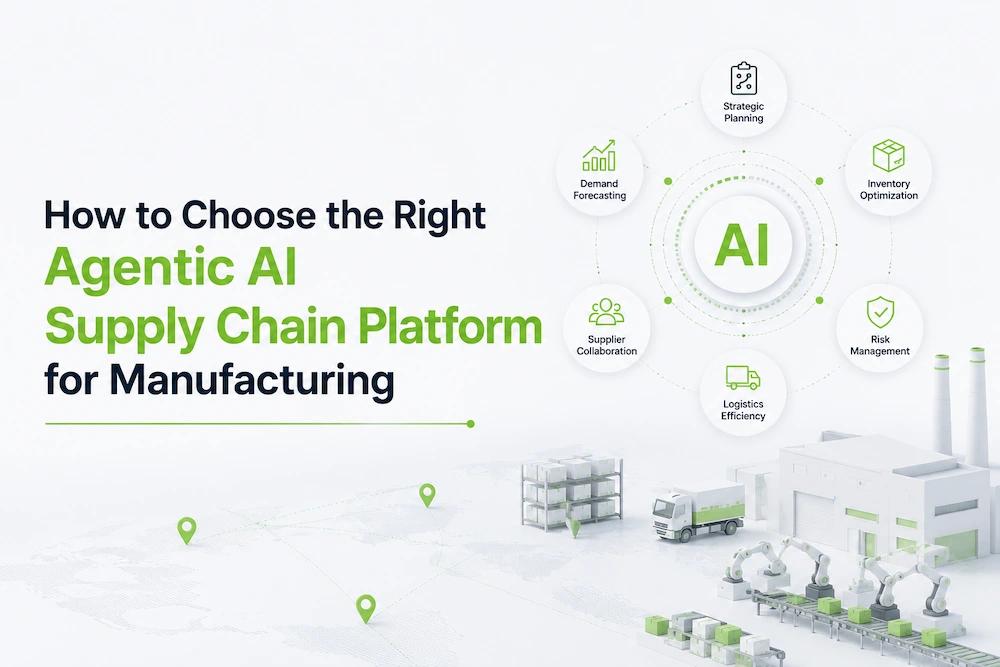
Manufacturing leaders face unprecedented pressure to modernize supply chain operations while managing global disruptions, cost volatility, and rising customer expectations. Understanding how to choose an agentic ai supply chain platform for manufacturing has become essential as these autonomous systems move from experimental pilots to production-ready solutions. Unlike traditional rule-based automation, agentic AI platforms operate independently, making real-time decisions across procurement, logistics, inventory, and production scheduling without constant human oversight.
Quick Takeaways
- Evaluate platforms based on autonomous decision scope, not just automation features
- Require demonstrated integration with your existing ERP, MES, and WMS systems
- Confirm the vendor has manufacturing-specific training data and domain expertise
- Assess total cost of ownership including implementation, training, and ongoing optimization
- Prioritize platforms offering explainable AI for regulatory compliance and audit trails
- Verify security architecture meets manufacturing cybersecurity standards
- Request references from similar-sized manufacturers in your industry segment
Comparison Table: Key Platform Evaluation Criteria
| Evaluation Criteria | Must-Have Features | Nice-to-Have Features | Red Flags |
|---|---|---|---|
| Autonomous Capabilities | Real-time demand sensing, automated reorder triggers | Self-optimizing inventory parameters | Requires manual approval for routine decisions |
| Integration Depth | Native ERP connectors, API-first architecture | Pre-built MES integrations | Custom coding required for basic integrations |
| Decision Transparency | Audit trails, reasoning explanations | Visual decision flowcharts | Black-box outputs with no explainability |
| Scalability | Multi-site deployment, cloud-native | Edge computing support | Single-site limitations |
| Industry Expertise | Manufacturing-specific models | Vertical specialization | Generic AI without domain tuning |
| Implementation Timeline | 6-12 month production deployment | Phased rollout options | 18+ month implementation estimates |
| Security Standards | SOC 2 Type II, ISO 27001 | Zero-trust architecture | No manufacturing security certifications |
Understanding Agentic AI in Supply Chain Context
Agentic AI represents a fundamental shift from reactive automation to proactive, autonomous supply chain management. These platforms deploy specialized AI agents that perceive supply chain conditions, reason through complex scenarios, and execute decisions independently.
In manufacturing environments, agentic AI platforms typically deploy multiple coordinated agents. A demand forecasting agent continuously analyzes sales patterns, market signals, and external factors. A procurement agent monitors supplier performance, pricing fluctuations, and lead time variations. An inventory optimization agent balances carrying costs against stockout risks across distribution networks.
According to Gartner's 2025 Supply Chain Technology Survey, 67% of manufacturing organizations plan to deploy agentic AI capabilities by 2027, up from just 12% in 2024. This rapid adoption creates urgency for platform selection decisions.
The distinction between traditional AI and agentic AI matters significantly for evaluation. Traditional machine learning models provide predictions that humans must act upon. Agentic systems combine prediction with action, executing purchase orders, adjusting production schedules, and rerouting shipments autonomously within defined parameters.
Organizations exploring custom AI agents development should understand that supply chain applications require both breadth of autonomous capabilities and depth of manufacturing domain knowledge.
Essential Capabilities for Manufacturing Supply Chains
The right platform must address manufacturing-specific supply chain challenges that generic enterprise AI cannot adequately handle.
Demand Sensing and Forecasting
Agentic platforms should ingest and process diverse demand signals automatically. This includes point-of-sale data, distributor inventory levels, economic indicators, weather patterns, and social media sentiment. The platform should demonstrate improvement over traditional statistical forecasting methods, with manufacturers typically achieving 20-35% forecast accuracy gains.
Intelligent Inventory Optimization
Autonomous inventory management requires balancing multiple competing objectives. The platform should optimize safety stock levels dynamically based on lead time variability, demand uncertainty, and service level targets. Multi-echelon inventory optimization across raw materials, work-in-process, and finished goods presents complexity that separates capable platforms from basic solutions.
Manufacturers seeking comprehensive inventory automation should explore supply chain planning AI solutions that integrate forecasting with replenishment execution.
Supplier Risk Management
Agentic platforms must continuously monitor supplier ecosystems for disruption signals. This includes financial health indicators, geopolitical risks, capacity constraints, and quality trends. The platform should autonomously adjust sourcing strategies, trigger qualification of backup suppliers, and negotiate emergency procurement when risks materialize.
Production Schedule Integration
Supply chain decisions directly impact production operations. The platform must bidirectionally integrate with manufacturing execution systems, adjusting material flow based on actual production consumption and communicating supply constraints that require schedule modifications.
Deeper integration with production planning AI systems creates closed-loop optimization between supply chain and manufacturing operations.
Logistics Optimization
Transportation and distribution decisions benefit significantly from autonomous optimization. The platform should dynamically select carriers, optimize routes, consolidate shipments, and adjust delivery schedules based on real-time conditions and cost-service tradeoffs.
Integration Requirements and Technical Architecture
Successful deployment depends on seamless integration with existing manufacturing technology ecosystems. Technical due diligence should verify compatibility and connectivity approaches.
ERP System Connectivity
The platform must integrate deeply with SAP, Oracle, Microsoft Dynamics, or other enterprise resource planning systems. Native connectors reduce implementation complexity compared to custom API development. Bidirectional data synchronization ensures AI decisions reflect current master data and transactional records.
Manufacturing Execution System Integration
Real-time visibility into shop floor operations enables responsive supply chain decisions. The platform should consume production status, quality events, and equipment availability from MES systems. This integration proves essential for just-in-time manufacturing environments.
Warehouse Management Connectivity
Inventory accuracy depends on tight integration with warehouse management systems. The platform should reconcile physical inventory positions, incorporate put-away and picking constraints, and coordinate with warehouse labor planning.
Data Architecture Considerations
Evaluate whether the platform requires data replication to cloud environments or operates on data in place. Manufacturing organizations with data residency requirements must verify compliance with regional regulations. Organizations should review approaches to AI integration in custom business software environments.
API and Extension Framework
Get Expert Guidance on Agentic AI Platform Selection
Schedule ConsultationThe platform should provide robust APIs for custom integrations and extensions. Manufacturing environments inevitably require connections to specialized systems not covered by standard connectors.
Vendor Evaluation Framework
Systematic vendor assessment reduces selection risk and ensures alignment with organizational requirements.
Manufacturing Domain Expertise
Prioritize vendors demonstrating deep manufacturing supply chain expertise. Generic AI platforms lack the domain-specific training data and operational understanding required for manufacturing contexts. Evaluate the vendor's customer base composition, focusing on manufacturing concentration and industry vertical expertise.
Implementation Track Record
Request detailed case studies from similar-sized manufacturing organizations. Verify implementation timelines, actual versus projected ROI, and ongoing support satisfaction. Speaking directly with reference customers provides insights beyond vendor-curated success stories.
Technology Roadmap Alignment
Understand the vendor's product development direction. Manufacturing supply chain requirements evolve rapidly, and the platform should demonstrate commitment to continuous capability enhancement. Evaluate the vendor's investment in emerging areas like autonomous mobile robots integration and digital twin connectivity.
Financial Stability Assessment
Supply chain platforms represent long-term technology commitments. Assess vendor financial health, funding sources, and market position. Early-stage vendors may offer innovative capabilities but carry higher continuity risk.
Comprehensive AI services vendor comparison for enterprise manufacturing helps organizations benchmark options systematically.
Support and Partnership Model
Evaluate the vendor's support structure, including implementation services, training programs, and ongoing optimization assistance. Manufacturing supply chains require continuous refinement as business conditions change.
Implementation and Change Management Considerations
Platform selection must account for organizational readiness and change management requirements that often determine deployment success.
Phased Deployment Strategy
Successful implementations typically follow phased approaches. Initial deployment might focus on demand forecasting improvements before expanding to autonomous replenishment decisions. This progression builds organizational confidence in AI decision quality.
Human-AI Collaboration Design
Define appropriate boundaries for autonomous decision-making versus human oversight. High-value or high-risk decisions may require human approval initially, with boundaries expanding as trust develops. The platform should support configurable autonomy levels across different decision types.
Skills Development Requirements
Supply chain teams require new capabilities to work effectively with agentic systems. Training should address AI literacy, exception handling, and performance monitoring. Organizations may need to recruit data science and AI operations talent.
Establishing AgentOps capabilities ensures ongoing monitoring, optimization, and governance of deployed AI agents.
Performance Measurement Framework
Define success metrics before deployment. Key performance indicators should span operational improvements like forecast accuracy and inventory turns, financial outcomes like working capital reduction and logistics cost savings, and strategic benefits like supplier risk mitigation.
Security and Compliance Requirements
Manufacturing supply chain platforms handle sensitive operational and commercial data requiring robust security frameworks.
Data Protection Standards
Verify the platform meets relevant security certifications including SOC 2 Type II and ISO 27001. Manufacturing organizations in regulated industries must confirm compliance with sector-specific requirements.
Access Control Architecture
The platform should support granular role-based access controls. Different user groups require varying visibility and decision authority levels. Integration with enterprise identity management systems simplifies administration.
Audit and Explainability
Regulatory environments increasingly require AI decision explainability. The platform should maintain comprehensive audit trails documenting decision rationale, data inputs, and outcomes. This capability proves essential for procurement compliance and financial auditing.
Cybersecurity Considerations
Supply chain platforms present attractive targets for cyber threats. Evaluate the vendor's security architecture, vulnerability management practices, and incident response capabilities. Manufacturing-specific threats like industrial espionage require heightened attention.
Use Cases: Where Agentic AI Delivers Maximum Value
Agentic AI supply chain platforms create measurable value across multiple operational scenarios.
Demand Volatility Response
When demand patterns shift rapidly, agentic platforms automatically adjust forecasts, modify replenishment quantities, and communicate production schedule changes. A consumer electronics manufacturer reduced stockouts by 43% during product launch periods using autonomous demand response.
Supplier Disruption Management
Platforms monitoring supplier risk indicators can autonomously qualify and activate backup suppliers when primary sources experience disruptions. An automotive components manufacturer maintained production continuity during a major supplier quality issue through automated alternate sourcing.
Multi-Site Inventory Balancing
Autonomous transfer optimization moves inventory between facilities to balance network-wide service levels and carrying costs. A building materials manufacturer reduced total inventory investment by 18% while improving fill rates through automated rebalancing.
Predictive Supply Chain Maintenance
Integration with predictive maintenance AI systems enables proactive material positioning for planned maintenance activities, reducing production downtime and emergency expediting costs.
Ready to Transform Your Supply Chain Operations?
Talk to Our ExpertsIndustry Applications Across Manufacturing Sectors
Agentic AI platform requirements vary by manufacturing industry segment.
Discrete Manufacturing
Automotive, aerospace, and industrial equipment manufacturers benefit from platforms excelling at complex bill of materials management, multi-tier supplier visibility, and long-horizon planning. Just-in-sequence delivery requirements demand tight logistics optimization.
Process Manufacturing
Chemical, food and beverage, and pharmaceutical manufacturers require platforms handling continuous production processes, shelf-life constraints, and batch tracking requirements. Quality compliance integration proves especially important.
Consumer Goods
High-volume consumer products manufacturers prioritize demand sensing capabilities and promotional planning integration. Rapid product lifecycle management and seasonal demand patterns require adaptive forecasting approaches.
Industrial Equipment
Capital equipment and aftermarket parts manufacturers require platforms managing diverse SKU portfolios with intermittent demand patterns. Service parts optimization differs significantly from production material management.
Buyer Journey Insights: From Evaluation to Selection
Understanding the typical procurement process helps organizations navigate platform selection efficiently.
Discovery Phase
Initial research should focus on understanding agentic AI capabilities and identifying potential vendors. Industry analyst reports from Gartner, Forrester, and IDC provide useful starting points. Peer networking through manufacturing associations offers practical insights.
Requirements Definition
Document specific supply chain challenges, integration requirements, and success criteria before engaging vendors. This foundation enables meaningful comparisons across platform options.
Vendor Shortlisting
Narrow consideration to three to five platforms demonstrating relevant manufacturing expertise and integration capabilities. Request detailed demonstrations addressing specific use cases rather than generic presentations.
Proof of Concept
Require working pilots using actual organizational data before final selection. Pilots should address the highest-priority use cases and integration scenarios. Evaluate both technical performance and user experience during pilots.
Commercial Negotiation
Negotiate contracts addressing total cost of ownership, implementation support, performance guarantees, and exit provisions. Manufacturing supply chain platforms represent significant multi-year investments warranting thorough commercial terms.
Conclusion
Selecting the right agentic AI supply chain platform requires balancing autonomous capability with integration depth, vendor expertise with implementation risk, and innovation with proven reliability. Manufacturing organizations that methodically evaluate how to choose agentic ai supply chain platform for manufacturing position themselves for competitive advantage through more responsive, resilient, and efficient supply chain operations.
Success depends on clear requirements definition, thorough vendor evaluation, and realistic implementation planning. Organizations should expect 6 to 12 month deployment timelines for initial use cases, with ROI realization typically within 12 to 18 months.
The manufacturing supply chain landscape will continue evolving rapidly through 2026 and beyond. Platforms demonstrating both current capability maturity and committed development roadmaps offer the best foundation for long-term supply chain transformation