Quick Answer
IT solutions for manufacturing companies include managed IT services, cloud infrastructure, cybersecurity, ERP integration, industrial networking, and AI-powered operations that keep production running efficiently. Unlike standard enterprise IT, manufacturing IT must support OT/IT convergence, legacy equipment, and 24/7 plant uptime. The right manufacturing IT partner helps reduce downtime, improve operational visibility, strengthen security, and accelerate digital transformation across the factory floor.
Manufacturing environments place demands on IT that most generic technology providers are not equipped to meet. A plant floor runs 24 hours a day, 365 days a year. Legacy equipment communicates over protocols that predate modern networking. Operational technology and information technology now share the same infrastructure, creating security and integration challenges that do not exist in office environments. And a single hour of unplanned downtime in a production facility costs between $100,000 and $300,000 depending on the operation.
This is why manufacturing IT services have become a specialized discipline. The firms and teams delivering IT solutions for manufacturing today are not just managing servers and helpdesks. They are integrating industrial systems with enterprise data platforms, securing converged OT/IT environments, enabling AI-driven predictive maintenance, and ensuring that every technology layer supports continuous production rather than interrupting it.
This guide covers what manufacturing IT solutions actually include, how IT support for manufacturing differs from standard enterprise IT, and how to evaluate IT services for manufacturing companies that can support both current operations and future digital transformation goals.
What Are IT Solutions for Manufacturing?
IT manufacturing solutions encompass every technology system and service that supports production operations, supply chain management, quality control automation, workforce coordination, and business intelligence across a manufacturing enterprise.
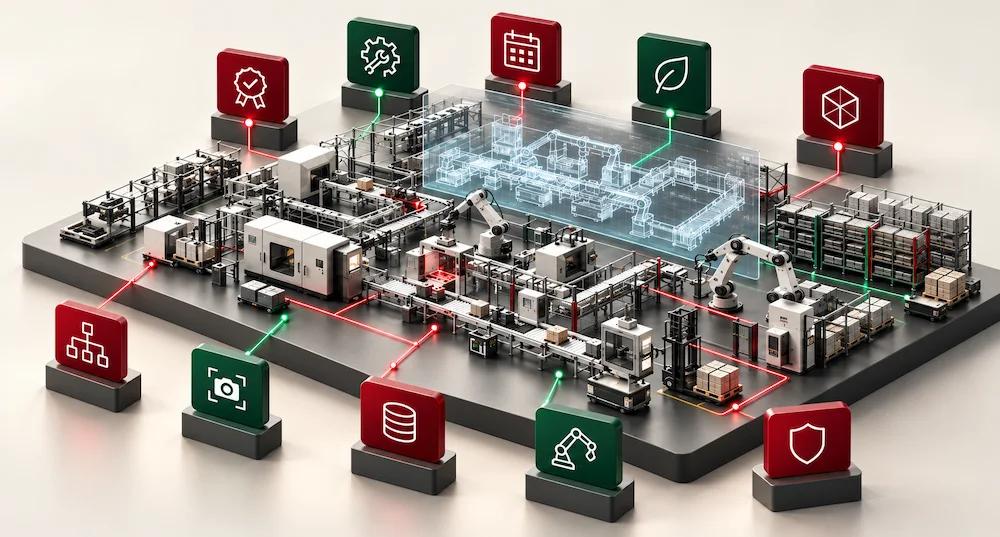
At the infrastructure level, this includes plant floor networking, industrial control system connectivity, and the integration between operational technology (OT) and information technology (IT) systems. At the application layer, it covers ERP platforms such as SAP and Oracle, manufacturing execution systems (MES), quality management software, and supply chain management tools. At the data and intelligence layer, it includes data pipelines, analytics platforms, and increasingly, AI-powered systems for demand forecasting, predictive maintenance, and automated quality inspection.
The defining characteristic of IT solutions for manufacturing is that they must work within production constraints. Systems cannot be taken offline for maintenance during a production run. Integration with decades-old equipment is often required. And performance requirements are set by production throughput, not by user convenience.
Understanding how AI adoption fits into a manufacturing IT strategy is increasingly important as manufacturers move from isolated automation toward connected, intelligent production environments.
Core IT Services for Manufacturing Companies
Manufacturing IT services fall into several functional categories, each addressing a distinct layer of the technology stack.
Infrastructure and network management covers the physical and virtual layers: plant floor networks, industrial Ethernet, wireless connectivity for mobile equipment, and the integration between factory systems and enterprise networks. In modern facilities, this increasingly includes edge computing infrastructure that processes data from sensors and equipment locally before sending aggregates to central systems.
ERP integration and support ensures that enterprise resource planning systems remain connected to production reality. When a machine completes a production order, the ERP must know. When inventory falls below threshold, purchasing must be triggered. IT services for manufacturing companies maintain these integrations and support the ERP systems that drive planning, scheduling, and financial reporting.
Cybersecurity for OT/IT environments is one of the fastest-growing areas of manufacturing IT services. As plant floor systems connect to enterprise networks and the internet, the attack surface expands significantly. Industrial control systems were designed for reliability, not security. IT support for manufacturers must bridge this gap with segmentation, monitoring, and incident response capabilities designed for operational technology environments.
Data engineering and analytics connect production data to business intelligence. Sensor data, quality measurements, machine utilization rates, and energy consumption all generate value when captured, processed, and analyzed. Data engineering services for manufacturing build the pipelines that make this data accessible to the systems and people who need it.
Looking for IT services for your manufacturing operation?
Talk to Intellectyx ExpertsIT Support for Manufacturing: What Makes It Different
IT support for manufacturing differs from standard enterprise IT support in ways that matter operationally.
Uptime requirements are absolute. In an office environment, a server going down inconveniences workers. In a manufacturing plant, it can halt a production line. IT support for manufacturing must operate with response SLAs measured in minutes, not hours, and must prioritize resolution paths that minimize or eliminate production impact.
Equipment lifecycles are long. A CNC machine purchased in 2005 may be running software and communication protocols from the same era. IT support for manufacturers must maintain connectivity and integration for legacy systems that no longer receive vendor support, often bridging old and new technologies within the same production environment.
OT knowledge is essential. Plant floor systems run on protocols including Modbus, PROFINET, OPC-UA, and EtherNet/IP. IT support technicians without operational technology knowledge cannot effectively troubleshoot problems that span IT and OT systems. The best manufacturing IT support teams include both IT generalists and OT specialists.
Security priorities differ. In enterprise IT, confidentiality is often the primary concern. In manufacturing IT, availability is paramount. A security patch that requires a 30-minute restart may be acceptable on a corporate laptop and unacceptable on a production controller. IT support for manufacturing must balance security requirements against operational continuity in ways that standard IT teams are not trained to navigate.
Managed services for manufacturing environments that account for these OT/IT differences deliver measurably better uptime outcomes than generic managed service providers applying standard enterprise IT practices to plant floor environments.
Managed IT Services for Manufacturing
Managed IT services for manufacturing provide ongoing, proactive management of technology infrastructure rather than reactive break-fix support. For manufacturers, this distinction matters significantly.
Reactive IT support responds after problems occur. In a production environment, the problem has already cost money before the support ticket is opened. Managed IT services for manufacturing monitor systems continuously, identify anomalies before they become failures, and take corrective action proactively. This shift from reactive to proactive significantly reduces unplanned downtime.
The scope of managed IT services for manufacturing typically includes network monitoring and management, server and endpoint management, cybersecurity monitoring and response, backup and disaster recovery, cloud infrastructure management, and help desk support for plant floor and administrative personnel. Advanced providers extend this scope to include ERP support, data platform management, and AI system monitoring.
Cloud migration is an increasingly important component of managed IT services for manufacturing. Moving workloads from on-premise servers to cloud infrastructure reduces capital expenditure, improves scalability for seasonal production cycles, and enables remote monitoring and management capabilities that on-premise infrastructure cannot easily provide. Managed IT service providers with cloud expertise help manufacturers identify which workloads belong in the cloud, which require hybrid deployment, and which must remain on-premise due to latency or compliance requirements.
Service level agreements for managed IT services for manufacturing should specify uptime guarantees, response times for different incident severities, and escalation paths that account for production impact. A manufacturing operation running three shifts requires different SLA terms than a single-shift facility, and the managed IT services provider must understand these differences to set appropriate commitments.
Manufacturing IT Support Across the Plant Floor
Manufacturing IT support extends across the full physical environment of a production facility, not just the server room and employee desktops. This breadth is what separates manufacturing IT support from general enterprise IT.
On the plant floor, IT support for manufacturing covers the connectivity and reliability of industrial computers, human-machine interfaces (HMIs), barcode scanners, RFID readers, vision systems, and the networks connecting them. These devices often run embedded operating systems on aging hardware in harsh physical environments. Dust, vibration, temperature extremes, and continuous operation create failure modes that standard IT support is not designed to address.
In the warehouse and logistics areas, IT support encompasses warehouse management systems, conveyor control systems, automated guided vehicles (AGVs), and the integration between these systems and ERP and fulfillment platforms. As manufacturers adopt more automation, the IT systems managing that automation become production-critical infrastructure.
At the business level, manufacturing IT support covers the administrative systems that finance, HR, sales, and management rely on, as well as the reporting and analytics platforms that translate production data into business intelligence. DevOps practices applied to manufacturing IT enable faster deployment of updates and improvements to these systems while maintaining the stability that production environments require.
Need end-to-end manufacturing IT support?
Talk to Our Manufacturing IT SpecialistThe Role of AI in Manufacturing IT Solutions
AI has become an increasingly central component of IT solutions for manufacturing. Where IT once managed the systems that ran production, it now manages intelligent systems that actively optimize production.
Predictive maintenance is the most widely deployed AI application in manufacturing IT. Rather than replacing equipment on a fixed schedule or waiting for failure, predictive maintenance AI analyzes sensor data continuously to identify degradation patterns that precede equipment failure. This shifts maintenance from reactive or scheduled to condition-based, reducing both unplanned downtime and unnecessary preventive maintenance costs.
Demand forecasting AI uses historical production data, supply chain signals, and market indicators to help manufacturers plan production more accurately. Integrated with ERP and MES systems, these models reduce inventory carrying costs and improve on-time delivery rates.
Quality inspection AI uses computer vision to inspect products at production speeds that no human inspection team can match. These systems identify defects, dimensional variations, and surface anomalies in real time, routing non-conforming products before they progress to downstream operations.
Custom AI agent development for manufacturing enables manufacturers to build autonomous systems that orchestrate these AI capabilities within their specific operational context, rather than deploying isolated AI tools that each require separate integration and management.
How to Choose IT Services for Manufacturing Companies
Selecting the right IT services for manufacturing companies requires evaluating both technical capability and industry experience.
Look for providers with demonstrated experience in OT/IT integration. Ask specifically about their experience with the industrial protocols used in your environment and the ERP systems in your stack. A provider with deep SAP experience but no OT background will struggle with plant floor connectivity, while a provider strong on industrial automation but weak on enterprise platforms will fail at the business intelligence layer.
Evaluate their approach to cybersecurity for manufacturing environments. They should understand the difference between IT security practices and OT security requirements, and have specific experience with industrial control system security frameworks such as IEC 62443.
Assess their capability to support your digital transformation roadmap, not just your current environment. IT services for manufacturing companies that can only maintain existing systems will become a constraint as manufacturers adopt cloud platforms, AI systems, and advanced automation. Providers that combine operational IT support with digital transformation expertise deliver more long-term value.
Finally, evaluate their SLA structure against your production requirements. A provider that offers standard enterprise IT SLAs will not meet the uptime and response requirements of a continuous production environment. The SLA should reflect manufacturing-specific uptime requirements, plant floor response times, and escalation procedures that account for production impact.
Conclusion
IT solutions for manufacturing have evolved from basic infrastructure management into a strategic function that directly affects production performance, quality, competitiveness, and profitability. The manufacturers gaining the most from their IT investments are those treating technology as an operational advantage rather than a cost center, working with IT services partners who understand the unique demands of production environments.
Whether the requirement is managed IT services for an existing plant, IT support for a new facility startup, or AI-driven optimization of production operations, the foundation is the same: purpose-built IT solutions for manufacturing that account for the operational, security, and integration realities of industrial environments.
Talk to Intellectyx about IT solutions and managed services for your manufacturing operation