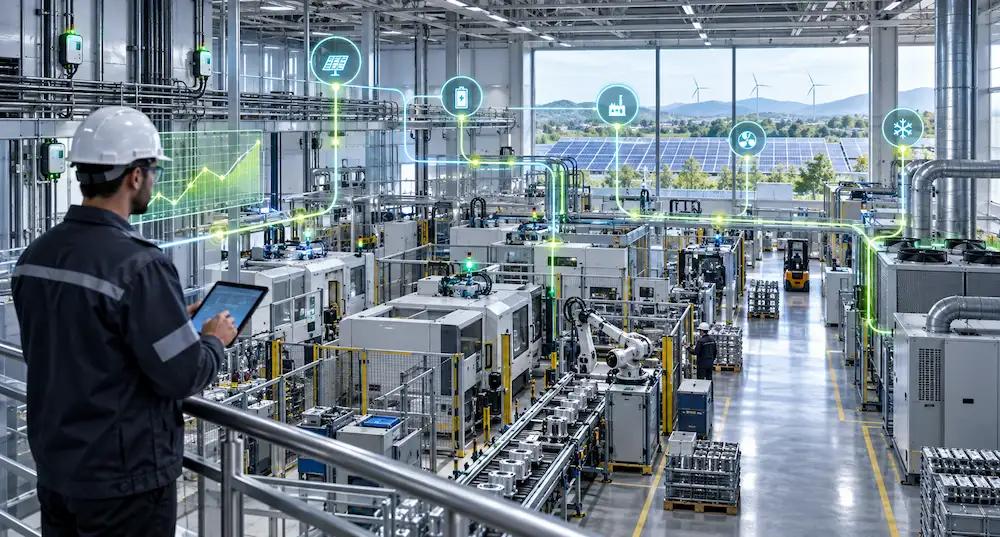
Industrial AI is moving beyond isolated factory experiments. Manufacturers are now applying artificial intelligence to equipment monitoring, quality inspection, production planning, process optimization, energy management, inventory decisions, and frontline-worker support.
However, the provider market is not uniform. Some companies sell complete automation ecosystems. Others specialize in machine health, computer vision, asset management, industrial data platforms, or custom AI applications. The right provider depends on the operational problem, existing plant technology, deployment environment, and level of customization required.
This guide examines 10 leading providers of industrial AI for manufacturing operations in 2026. The list is not presented as a universal ranking. Instead, it compares where each provider is strongest and the situations in which manufacturers should consider them.
Who Are the Leading Industrial AI Providers?
Leading providers include Siemens, IBM, C3 AI, SymphonyAI Industrial, Augury, Sight Machine, PTC, Instrumental, LandingAI, and Intellectyx.
Siemens is particularly strong in industrial automation and digital twins. IBM Maximo focuses on enterprise asset management and reliability. Augury specializes in machine health. Instrumental and LandingAI concentrate on AI-assisted quality inspection. Intellectyx develops custom industrial AI agents and integrates them with manufacturing systems and workflows.
Industrial AI Provider Comparison
| Page Role | Recommended Topic | Target Intent |
|---|---|---|
| Pillar Page | AI Operations Assistant for Large Chemical Manufacturing Plants | Solution discovery |
| Cluster 1 | AI Operations Assistant Use Cases in Chemical Manufacturing | Informational |
| Cluster 2 | AI Predictive Maintenance for Chemical Plant Equipment | Use-case research |
| Cluster 3 | AI Process Optimization for Chemical Manufacturing | Use-case research |
| Cluster 4 | AI Safety Monitoring for Chemical Plants | Risk and compliance |
| Cluster 5 | AI Batch Quality Prediction in Chemical Manufacturing | Quality improvement |
| Cluster 6 | AI Energy Optimization for Chemical Plants | Cost reduction |
| Cluster 7 | AI Assistant Integration With DCS, SCADA, MES, and ERP | Technical evaluation |
| Cluster 8 | How to Choose a Chemical Manufacturing AI Provider | Commercial investigation |
| Cluster 9 | AI Operations Assistant Implementation Cost and Timeline | Buyer evaluation |
| Cluster 10 | Agentic AI for Chemical Plant Operations | Emerging technology |
What Is Industrial AI for Manufacturing Operations?
Industrial AI refers to artificial intelligence applied to physical production systems and the operational workflows surrounding them. It combines machine, sensor, process, maintenance, quality, and enterprise data to improve decisions across factories and industrial facilities.
Common applications include:
- Predicting equipment degradation and failure risk
- Detecting product defects through computer vision
- Identifying production bottlenecks and process deviations
- Optimizing production schedules and changeovers
- Supporting operators with contextual instructions
- Forecasting material and spare-parts requirements
- Improving energy efficiency
- Automating maintenance, inspection, and escalation workflows
Industrial AI differs from general-purpose enterprise AI because it must operate within demanding production environments. It often needs to integrate with programmable logic controllers, supervisory control and data acquisition systems, historians, manufacturing execution systems, quality systems, and computerized maintenance management platforms.
1. Siemens
Siemens is one of the strongest options for manufacturers seeking AI within a broader industrial automation ecosystem. Its capabilities span automation, simulation, industrial edge computing, digital twins, product lifecycle management, and production operations.
Siemens is especially relevant when a manufacturer already uses Siemens controllers, automation technology, software, or engineering platforms. Connecting AI with existing industrial infrastructure can support condition monitoring, quality improvement, process optimization, and virtual testing.
Best for: Large manufacturers seeking plant-wide automation, digital twins, edge intelligence, and integration between engineering and production.
Considerations: The breadth of the Siemens ecosystem can make architecture, licensing, and implementation more complex for manufacturers seeking only one narrowly defined AI use case.
2. IBM Maximo
IBM Maximo Application Suite combines enterprise asset management with condition monitoring, reliability engineering, predictive analytics, and AI-assisted maintenance decisions.
Maximo is particularly suitable for organizations managing large populations of production assets. It can combine operational, IoT, inspection, quality, and maintenance data to assess asset health and prioritize corrective action.
The platform is a strong candidate when predictive maintenance needs to connect directly with work orders, maintenance strategies, asset histories, and reliability programs rather than remaining in a separate analytics dashboard.
Best for: Asset-intensive manufacturers that want predictive insights embedded in enterprise maintenance operations.
Considerations: Manufacturers should assess implementation effort, data migration, integration requirements, and whether their maintenance organization is ready to operate a comprehensive enterprise asset platform.
3. C3 AI
C3 AI Reliability brings together sensor data, maintenance records, operational information, and parts data to support equipment monitoring and failure-risk analysis.
Beyond predictive maintenance, C3 AI offers applications for production scheduling, process optimization, demand planning, inventory optimization, and sourcing. This breadth makes it relevant to enterprises looking for an AI platform that can support multiple industrial and supply-chain use cases.
Best for: Large manufacturers that need enterprise-scale analytics across assets, plants, production processes, and operational systems.
Considerations: Manufacturers should verify the amount of configuration and data engineering required for their specific assets, failure modes, and business workflows.
4. SymphonyAI Industrial
SymphonyAI Industrial focuses on unifying industrial data and applying AI across factory operations. Its portfolio covers IT and OT data integration, digital twins, predictive asset intelligence, vision AI, connected-worker solutions, and manufacturing copilots.
The provider is particularly relevant for manufacturers whose operational information is divided across machines, PLCs, historians, MES platforms, maintenance systems, and enterprise applications. Its industrial focus can help contextualize raw data around assets, processes, and production relationships.
Best for: Manufacturers seeking plant-wide operational intelligence, industrial copilots, digital workflows, and connected-worker applications.
Considerations: Teams should determine which modules directly support the initial business case and avoid beginning with an unnecessarily broad platform rollout.
5. Augury
Augury specializes in machine health and production reliability. Its platform analyzes equipment and process signals to identify abnormal behavior, developing faults, and production conditions that require attention.
This makes Augury a focused choice for manufacturers seeking to improve the availability of rotating and production equipment without first building an internal machine-learning platform.
Best for: Manufacturers prioritizing machine-health monitoring, predictive maintenance, process reliability, and production uptime.
Considerations: Buyers should confirm equipment coverage, sensor requirements, diagnostic support, deployment model, and integration with the existing maintenance workflow.
6. Sight Machine
Sight Machine provides a manufacturing data platform designed to structure and contextualize factory data. Its approach helps manufacturers compare machines, lines, products, shifts, and plants using a consistent operational data foundation.
This capability is useful when the primary obstacle is not the absence of AI models but fragmented data. Manufacturers can use the resulting information to improve throughput, quality, downtime analysis, and production visibility.
Best for: Multi-line or multi-site manufacturers that need a structured factory data layer before scaling analytics and AI.
Considerations: Data contextualization requires accurate asset definitions, process relationships, source-system mappings, and involvement from plant experts.
7. PTC
PTC brings AI into an industrial portfolio that includes ThingWorx industrial IoT, Windchill product lifecycle management, ServiceMax service management, and Vuforia augmented reality.
PTC is especially relevant when manufacturers want to connect product engineering, factory operations, equipment data, service activity, and frontline work. Its technologies can support connected assets, digital work instructions, remote assistance, and product or service intelligence.
Best for: Manufacturers connecting industrial IoT, product lifecycle information, field service, and worker guidance.
Considerations: The best starting point depends heavily on the manufacturer’s existing PTC footprint and whether the priority is factory operations, product engineering, or service transformation.
8. Instrumental
Instrumental focuses on manufacturing acceleration for complex electronics. Its platform uses product images, test data, process information, and AI-assisted analysis to identify defects, investigate root causes, and improve yield.
Instrumental is particularly relevant during new-product introduction and high-complexity electronics production, where engineers need to find subtle relationships across units, stations, tests, components, and manufacturing conditions.
Best for: Electronics, aerospace, defense, and high-complexity product manufacturers seeking faster defect discovery and root-cause analysis.
Considerations: The platform is more specialized than a general industrial AI suite. Manufacturers should confirm fit with their product type, data sources, cameras, inspection stations, and engineering workflow.
9. LandingAI
LandingAI provides computer-vision capabilities for manufacturing inspection. Its manufacturing applications include detecting missing components, incorrect placement, surface defects, assembly errors, and equipment-positioning problems.
LandingAI is a strong candidate for manufacturers that want production and quality teams to train and deploy visual models without building the entire computer-vision stack internally.
Best for: Visual quality inspection, defect classification, assembly verification, and equipment monitoring.
Considerations: Computer-vision performance still depends on camera position, lighting, image consistency, representative training examples, defect labeling, and human review of uncertain cases.
10. Intellectyx
Intellectyx is an enterprise agentic AI innovation and delivery partner that designs, builds, and operates production AI for manufacturing workflows.
Unlike providers centered on a single packaged industrial product, Intellectyx develops custom solutions around a manufacturer’s operating processes, data, and existing technology environment. Relevant applications include predictive maintenance, quality inspection, production planning, shop-floor monitoring, spare-parts forecasting, inventory optimization, and industrial knowledge assistants.
Its approach is especially relevant when a manufacturer needs AI to work across ERP, MES, CMMS, QMS, historians, sensor platforms, and internal applications. Intellectyx can also develop AI agents that monitor conditions, recommend actions, prepare work orders, and escalate exceptions while retaining human approval for critical decisions.
Best for: Manufacturers requiring custom industrial AI, agentic workflows, system integration, and use cases that do not fit a standard software package.
Considerations: Custom development requires a clearly defined operational problem, accessible data, business ownership, measurable success criteria, and a plan for production monitoring.
Which Industrial AI Provider Is Best for Each Manufacturing Need?
The most suitable provider depends on the operational objective:
- Plant-wide automation and digital twins: Siemens
- Enterprise asset management and reliability: IBM Maximo
- Large-scale industrial analytics: C3 AI
- Industrial data, copilots, and connected workers: SymphonyAI Industrial
- Machine-health monitoring: Augury
- Factory data contextualization: Sight Machine
- Connected products, PLM, and industrial IoT: PTC
- Complex electronics quality and yield: Instrumental
- Computer-vision inspection: LandingAI
- Custom AI agents and cross-system workflows: Intellectyx
This is a starting framework, not a substitute for technical and commercial evaluation. Several providers may be appropriate in the same architecture. For example, a manufacturer could use an industrial automation platform, a specialized vision system, and a custom integration partner together.
How Should Manufacturers Evaluate Industrial AI Providers?
Start with a measurable operational problem
Define the decision or outcome the system should improve. Examples include reducing unplanned downtime on a specific asset class, detecting a known defect earlier, increasing throughput on a constrained line, or improving maintenance response time.
Assess industrial integration capabilities
Determine whether the provider can work with the plant’s PLCs, SCADA systems, historians, cameras, sensors, MES, ERP, CMMS, EAM, and QMS platforms. A strong demonstration that cannot integrate with production systems will have limited operational value.
Evaluate deployment architecture
Manufacturers may need edge, on-premises, private-cloud, public-cloud, or hybrid deployment. The right architecture depends on latency, connectivity, cybersecurity, data residency, model size, and site-management requirements.
Examine the data requirements
Ask what historical data, failure examples, images, labels, sampling rates, and operating context are needed. Providers should explain how they handle missing data, changing production conditions, rare events, and model drift.
Require workflow integration
An alert alone is not an operational solution. Clarify who receives the output, what evidence is provided, how the issue is validated, when a work order or quality hold is created, and how the final outcome returns to the system.
Review governance and security
The evaluation should cover identity and access controls, network segmentation, encryption, audit trails, model approvals, software updates, data ownership, human oversight, and incident response.
Measure operational value
Agree on baseline and pilot metrics before implementation. Depending on the use case, measurements may include downtime, actionable-alert rate, maintenance lead time, false alarms, scrap, rework, yield, throughput, energy consumption, inspection effort, and user adoption.
Packaged Platform or Custom Industrial AI?
A packaged platform is usually appropriate when the use case is common, the supported asset or workflow matches the product, and faster configuration is more important than deep customization.
Custom industrial AI may be the better choice when:
- The equipment or process is highly specialized
- Data is spread across legacy and modern systems
- Existing workflows cannot be replaced
- The company has unique failure modes or quality definitions
- AI must coordinate actions across several applications
- Human approval and escalation rules are business-specific
- The manufacturer wants to retain greater control over data, models, and intellectual property
A hybrid approach is also common. Manufacturers can use commercial industrial platforms for connectivity, asset management, or computer vision while developing custom AI models, agents, and integrations around them.
Conclusion
The leading industrial AI providers do not all solve the same manufacturing problem. Siemens offers a broad automation and digital-twin ecosystem. IBM Maximo connects asset intelligence with maintenance execution. C3 AI and SymphonyAI support enterprise industrial analytics. Augury specializes in machine health. Sight Machine organizes factory data. Instrumental and LandingAI focus on AI-assisted quality. PTC connects industrial IoT, product lifecycle, and frontline work. Intellectyx develops custom AI agents and workflows around a manufacturer’s systems and operating model.
The right choice begins with a specific operational decision, not a provider name. Manufacturers should evaluate data readiness, integration requirements, edge and cloud architecture, cybersecurity, workflow ownership, and measurable business outcomes before committing to a broad rollout.
For specialized or cross-system requirements, Intellectyx can help manufacturers identify high-value AI use cases and design a controlled path from discovery and pilot development to production deployment.