
For decades, financial institutions have led technology adoption, from mainframes to mobile banking, from rule-based fraud detection to machine-learning credit models. But agentic AI is not another incremental upgrade. It is a fundamental shift in what artificial intelligence can do inside a bank, a fintech, or a finance function. The question finance leaders are now asking is not "Should we use AI?" It is "What happens when AI stops waiting to be asked and starts making decisions on its own?"
How Is Agentic AI Different from Traditional AI and Generative AI?
Financial services have moved through three generations of AI, each more autonomous than the last.
Traditional rule-based AI follows pre-defined instructions. Fraud flags trigger when criteria are met. Credit scores are output based on fixed variables. Powerful within constraints, but entirely deterministic.
Generative AI in Lending operations was a genuine leap, drafting credit memos, summarizing regulatory documents, and answering customer queries with nuance. But these systems are fundamentally reactive. They wait for a human prompt before doing anything.
Agentic AI changes everything. You give it an objective, "Monitor this lending portfolio for early warning signs" and it determines what data to pull, which patterns matter, when thresholds are crossed, and what actions to take. No constant human oversight required.
The simplest way to frame it: traditional AI does what it is told. Generative AI answers when spoken to. Agentic AI pursues objectives.
How Does Agentic AI in Finance Work?
At the core is a large language model connected to real tools APIs, databases, trading platforms, ERP systems, and compliance databases. This tool-use capability transforms a conversational model into an agent that can actually execute actions, not just describe them.
Retrieval-augmented generation (RAG) grounds the agent's reasoning in live institutional data. Feedback loops allow it to improve over time. And orchestration frameworks manage how multiple agents communicate, delegate tasks, and coordinate toward a shared goal, producing four defining capabilities: goal-directed reasoning, real-world tool execution, continuous adaptability, and multi-agent coordination.
Types of Agentic AI in Finance
Compliance and Regulatory Agents monitor transactions continuously against evolving regulatory frameworks, flag anomalies in real time, and generate audit trails, replacing periodic batch checks with always-on coverage.
Fraud Detection Agents identify behavioral patterns and non-obvious correlations across accounts that no pre-defined rule would catch. Given that 50% of all fraud today already involves AI, institutions need agents that can match the sophistication of AI-powered threats.
Credit Risk and Underwriting Agents move beyond the static credit snapshot. By continuously evaluating borrower solvency using real-time transaction data and macroeconomic signals, one US bank reported a 20–60% productivity increase and 30% improvement in credit turnaround time after deployment.
Customer Experience Agents go beyond scripted chatbots, anticipating needs and executing actions autonomously within pre-authorized parameters.
AI Agent for Payments Reconciliation and Back-Office Operations delivers some of the fastest and highest ROI for financial institutions. According to PwC, organizations deploying AI agents have achieved cycle time reductions of up to 80% in purchase order processing. Similarly, AI-powered reconciliation agents automatically match transactions across payment systems, identify discrepancies, investigate exceptions, reconcile accounts in real time, and generate audit-ready reports. By automating repetitive back-office tasks, banks can reduce manual effort, improve accuracy, accelerate financial close processes, and strengthen operational efficiency and compliance.
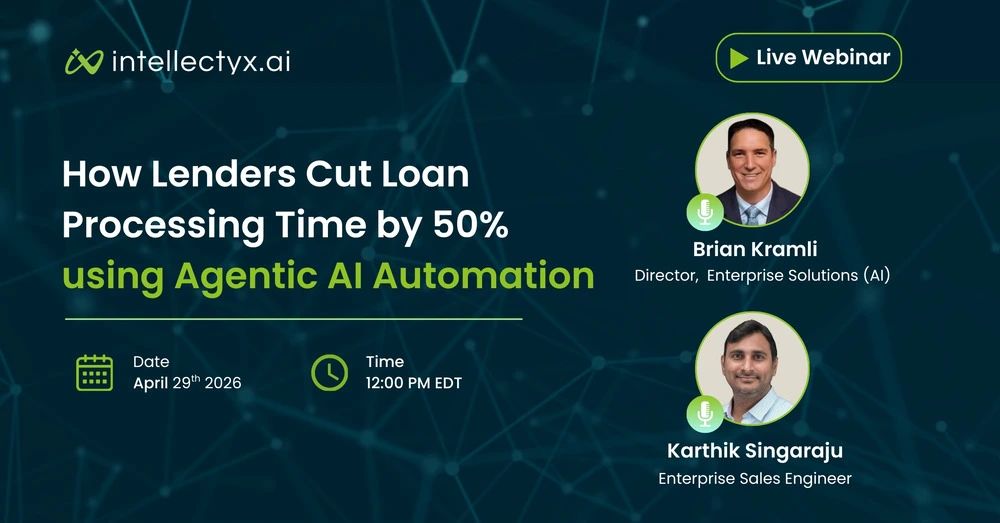
Cut Loan Processing Time by 50% Using Agentic AI
Join Our Webinar on April 29th to Learn How Lenders is using Agentic AI.
Register NowAgentic AI for Fintechs, Payments, and Embedded Finance
For fintechs, payment platforms, and embedded finance providers, agentic AI unlocks a specific set of capabilities that go well beyond what traditional automation can deliver. Intellectyx has built a purpose-designed agent framework for this segment, covering the full operational lifecycle.
Instant User and Partner Onboarding Agent collects KYC data, verifies through APIs, approves, and activates all autonomously. The result is 10x faster onboarding compared to manual processes, removing one of the biggest friction points in fintech growth.
Continuous KYC/KYB Monitoring Agent watches for regulatory updates, compares against existing partner profiles, flags discrepancies, and notifies compliance teams in real time. The outcome is always-compliant partner data without manual periodic reviews.
Sponsor Bank Oversight and Risk Agent tracks program performance, detects compliance anomalies across embedded finance programs, and escalates issues before they become regulatory events, delivering real-time compliance coverage for sponsor banks operating at scale.
Dispute and Chargeback Resolution Agent receives cases, gathers evidence autonomously, prepares responses, and tracks outcomes, delivering 60% faster dispute resolution and reducing the operational burden on customer operations teams.
The Payments Fraud and Threat Detection Agent monitors transactions continuously, detects suspicious patterns, blocks threats in real time, and learns from each incident to improve future detection. This adaptive approach is essential when fraud tactics evolve faster than static rules can be updated.
Dynamic Pricing and Margin Optimization Agent analyzes fees, recommends optimal routing, adjusts pricing dynamically, and tracks revenue impact, directly improving interchange revenue without requiring manual pricing committee cycles.
Embedded Finance Enablement Agent integrates APIs, automates partner onboarding, monitors program performance, and manages launch workflows, making scalable embedded finance operationally viable for platforms that could not previously manage the complexity.
Marketing and Compliance AI Copilot scans marketing content, checks against regulatory rules, flags violations, and approves compliant material, enabling zero-risk go-to-market campaigns without the bottleneck of manual legal and compliance review.
Customer Retention and Growth Agent tracks churn signals, suggests personalized offers, executes outreach, and measures campaign effectiveness, improving retention rates through continuous, data-driven engagement rather than periodic human-led campaigns.
Multi-Agent FinOps Orchestration ties everything together. Individual agents collaborate, exchange data, automate cross-functional decisions, and learn from outcomes, creating a unified autonomous FinOps layer that coordinates across the entire fintech operating model.
Take a look of Recent case study - Real AI case studies in banking
Best Practices: Autonomous AI Agents for Financial Reconciliation
Data standardization comes before the agent. MIT Sloan research found that 80% of effort in agentic AI deployments is data engineering, not model tuning. Define confidence thresholds and escalation paths from day one, high-confidence matches process automatically, and anything below the threshold routes to human review. Build immutable audit trails for every agent action, and track your straight-through processing rate from the start. These metrics build the business case for scaling.
How CFOs Can Implement AI Agents
Most AI Consulting firms for finance services start with a process audit, not a technology search. Map where your finance team spends the most time on repetitive, data-intensive work reconciliation, AP matching, regulatory reporting, period-end close, and quantify the current cost and cycle time.
Build governance infrastructure before deploying agents. Define what decisions agents can make autonomously, what requires human review, and how behavior will be audited. Run a focused pilot with clear success metrics first. Then invest in your team in parallel, McKinsey projects that finance employees will shift from spending 80% of their time on coordination and rule-based execution toward strategic analysis. That transformation requires change management alongside the technology, not as an afterthought.
Level Up Your Finance Functions With Intellectyx Agentic AI
The shift from automation to autonomous workflows is already underway. McKinsey estimates $170 billion in global banking profits could be at risk for institutions that fail to adapt. Intellectyx partners with banking and fintech leaders to design, build, and deploy production-grade agentic AI systems from multi-agent architecture and autonomous reconciliation to the full fintech agent suite covering onboarding, fraud, compliance, disputes, pricing, and FinOps orchestration.
Connect with the Intellectyx team to explore how agentic AI can benefit your finance function.
Don’t Miss Our Live Webinar – 29th April 2026
Learn How Lenders Reduce Loan Processing Time by 50% using Agentic AI.
Save Your Seat Now