
Introduction
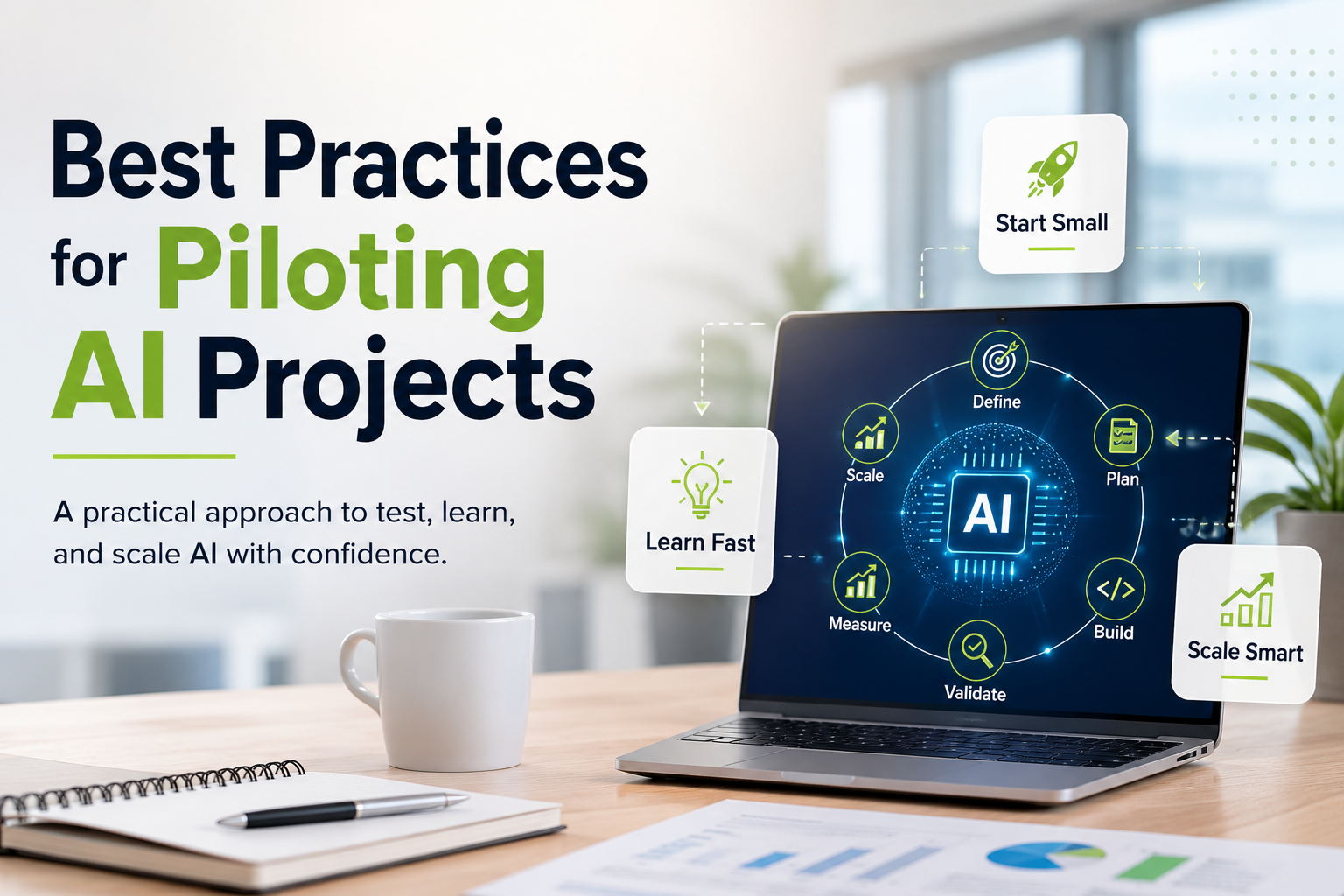
Organizations investing in artificial intelligence face a persistent challenge: most AI pilots never reach production. According to Gartner, only 53% of AI projects make it from prototype to deployment, leaving enterprises with unrealized potential and wasted resources. Understanding the best practices for piloting AI projects is essential for any organization seeking meaningful returns on its AI investments.
The journey from initial experimentation to enterprise-wide implementation requires more than technical expertise. It demands strategic alignment, organizational readiness, and a clear pathway from AI pilot to production. This guide provides actionable frameworks that enterprise leaders can apply immediately to increase pilot success rates and achieve AI pilot-to-scalable transformation.
What Makes AI Pilots Succeed?
Successful AI pilots combine clear business objectives, executive sponsorship, quality data foundations, cross-functional teams, and measurable success criteria. Organizations that define specific KPIs, secure stakeholder buy-in before launch, and plan for production scaling from day one achieve 3x higher success rates than those treating pilots as isolated experiments.
Quick Takeaways
- Define business outcomes before selecting AI technology
- Secure executive sponsorship and cross-functional alignment early
- Start with high-impact, low-complexity use cases
- Establish data quality baselines before pilot launch
- Build production considerations into pilot architecture
- Create clear success metrics tied to business value
- Plan change management alongside technical implementation
- Document learnings systematically for organizational knowledge
AI Pilot Success Factors: Comparison Table
| Factor | Successful Pilots | Failed Pilots |
|---|---|---|
| Business Alignment | Specific revenue or cost targets | Vague efficiency goals |
| Executive Sponsorship | Active C-suite champion | IT-only initiative |
| Data Readiness | Assessed and prepared pre-pilot | Discovered during pilot |
| Team Composition | Cross-functional with clear roles | Technical siloes |
| Success Metrics | Quantifiable business KPIs | Technical performance only |
| Production Planning | Architecture designed for scale | Prototype-only mindset |
| Timeline | 8-16 weeks with milestones | Open-ended exploration |
| Change Management | Integrated from start | Afterthought |
Why Most AI Pilots Fail to Reach Production
The primary reason AI pilots stall is misalignment between technical proof-of-concept goals and actual business requirements. That misalignment often starts earlier when teams skip the critical step of understanding proof of concept vs pilot as distinct validation stages, each answering a different question before significant resources are committed.
Common Failure Patterns
Organizations frequently encounter these obstacles when attempting to move from experimentation to deployment:
Unclear Success Definition: Without predefined metrics tied to business outcomes, teams cannot determine whether a pilot succeeded. Technical accuracy alone does not guarantee business value.
Data Quality Gaps: Pilots often rely on curated datasets that do not capture the complexity of production data. When deployed against real-world data, model performance degrades significantly.
Integration Complexity: Prototype systems built in isolation face substantial challenges connecting to enterprise systems, security frameworks, and existing workflows.
Organizational Resistance: End users who were not involved in pilot design often resist adopting AI tools that change their established processes.
Scaling Architecture Gaps: Pilots built for demonstration cannot handle production volumes, latency requirements, or reliability standards.
For organizations exploring how to validate AI investments before full commitment, understanding the AI proof of concept guide provides foundational knowledge for structuring early experiments.
Best Practices for Piloting AI Projects: The Strategic Framework
Effective AI pilots follow a structured approach that balances speed with thoroughness. This framework addresses technical, organizational, and business dimensions simultaneously.
Phase 1: Strategic Alignment and Use Case Selection
Begin by identifying use cases where AI can deliver measurable business impact within existing operational constraints. The ideal pilot candidate exhibits these characteristics:
1. Clear Business Value: Quantifiable impact on revenue, cost, or risk
2. Data Availability: Sufficient quality data accessible within compliance boundaries
3. Stakeholder Readiness: Business owners willing to champion adoption
4. Technical Feasibility: Achievable with current AI capabilities
5. Integration Pathway: Realistic connection to existing systems
Prioritize use cases that score highly across all dimensions rather than optimizing for any single factor. A technically elegant solution without business sponsorship will stall just as surely as a well-funded initiative lacking adequate data.
Phase 2: Foundation Building
Before writing any code, establish the foundations that determine pilot success:
Data Assessment: Evaluate data quality, completeness, and accessibility. Identify gaps and remediation requirements. Document data lineage and governance requirements.
Team Assembly: Build cross-functional teams including data scientists, engineers, domain experts, and business stakeholders. Define roles, decision rights, and escalation paths.
Success Criteria: Establish specific, measurable targets for both technical performance and business outcomes. Ensure all stakeholders agree on what success looks like.
Governance Framework: Define ethical boundaries, compliance requirements, and risk tolerance levels before development begins.
Organizations seeking to build robust AI capabilities benefit from working with specialists in custom AI agents development who understand both technical implementation and enterprise requirements.
Phase 3: Iterative Development with Production Mindset
Develop the pilot solution using agile methodologies while maintaining production-readiness as a core design principle:
- Build modular architectures that can scale horizontally
- Implement logging, monitoring, and observability from the start
- Use containerization and infrastructure-as-code practices
- Create automated testing pipelines for continuous validation
- Document APIs and integration points thoroughly
Avoid the temptation to take shortcuts that save time during the pilot but create technical debt, preventing production deployment.
Ready to Transform Your AI Pilots into Production Success?
Schedule a Strategy SessionMoving from AI Pilot to Production: Critical Success Factors
The transition from successful pilot to production deployment requires deliberate planning across multiple dimensions. Organizations that treat this as a simple handoff rather than a managed transition frequently encounter costly delays.
Technical Readiness Assessment
Before declaring a pilot ready for production, validate these technical requirements:
Performance at Scale: Load tests the solution against production volumes. Verify that latency, throughput, and resource utilization meet requirements.
Reliability Engineering: Implement failover mechanisms, circuit breakers, and graceful degradation patterns. Define SLAs and monitoring alerts.
Security Hardening: Conduct security assessments covering authentication, authorization, data protection, and vulnerability management.
Integration Validation: Test all system integrations under realistic conditions, including error handling and edge cases.
Operational Readiness
Production systems require ongoing operational support that pilots typically lack:
Runbook Development: Create documented procedures for common operational tasks, incident response, and escalation paths.
Model Monitoring: Implement continuous monitoring for model drift, data quality changes, and performance degradation. Defining AI agent evaluation metrics before deployment gives production teams a structured framework for tracking task completion rates, decision accuracy, workflow success, and business ROI continuously not just at go-live.
Update Mechanisms: Establish processes for model retraining, version management, and rollback procedures.
For organizations managing multiple AI systems, implementing AgentOps practices ensures consistent governance and performance optimization across the AI portfolio.
Organizational Change Management
Technical deployment succeeds only when users adopt the new capabilities effectively:
Training Programs: Develop role-specific training covering both tool usage and process changes.
Communication Plans: Articulate the why behind changes, addressing concerns about job impact and workflow disruption.
Feedback Mechanisms: Create channels for users to report issues, suggest improvements, and share success stories.
Success Celebration: Recognize early adopters and share wins to build momentum across the organization.
Achieving AI Pilot to Scalable Transformation
Scaling beyond individual pilots to enterprise-wide AI transformation requires systematic capability building. Organizations that scale successfully treat AI as a strategic capability rather than a collection of point solutions.
Building Reusable Foundations
Invest in shared infrastructure that accelerates future AI initiatives:
Data Platforms: Centralized data repositories with consistent quality standards, governance, and accessibility.
MLOps Infrastructure: Standardized pipelines for model training, deployment, monitoring, and lifecycle management.
AI Centers of Excellence: Dedicated teams that establish best practices, provide consulting support, and maintain institutional knowledge.
Vendor Partnerships: Strategic relationships with technology providers and implementation partners who understand your industry context.
Portfolio Management Approach
Manage AI initiatives as a portfolio balancing risk, investment, and expected returns:
1. Quick Wins: Low-complexity projects delivering near-term value and building organizational confidence
2. Strategic Bets: Higher-complexity initiatives with transformational potential
3. Exploratory Pilots: Research-oriented experiments testing emerging capabilities
4. Infrastructure Investments: Platform capabilities enabling future initiatives
This balanced approach maintains momentum while building toward more ambitious transformations.
Measuring Transformation Progress
Track both leading and lagging indicators of AI transformation success:
Leading Indicators:
- Number of use cases in pilot, production, and scaled deployment
- Time from concept to production deployment
- Reuse rate of shared AI components
- Employee AI literacy scores
Lagging Indicators:
- Revenue impact from AI initiatives
- Cost reduction from AI automation
- Customer satisfaction improvements
- Competitive advantage metrics
Organizations that have successfully navigated transformation share their approaches through documented success stories that provide practical insights for others on similar journeys.
Industry Applications and Use Cases
Best practices for piloting AI projects apply across industries, though specific use cases and considerations vary by sector.
Manufacturing
Manufacturing organizations pilot AI for operational excellence:
Predictive Maintenance: Pilots typically focus on critical equipment with high downtime costs. Success requires sensor data integration and maintenance history analysis. The predictive maintenance AI agent approach demonstrates how to structure these initiatives for production readiness.
Accelerate Your AI Journey with Expert Partnership
Connect with Our TeamQuality Control: Computer vision pilots for defect detection require consistent imaging conditions and labeled training data. Production scaling demands integration with production line systems and real-time processing capabilities.
Demand Forecasting: Pilots validating forecast accuracy against historical data must account for production data complexity, including promotions, market changes, and supply disruptions.
Financial Services
Financial institutions face unique regulatory and risk management requirements:
Fraud Detection: Pilots must balance detection accuracy against false positive rates that impact customer experience. Production deployment requires explainability for regulatory compliance.
Loan Underwriting: AI pilots in lending require careful validation against fair lending requirements and regulatory expectations. Organizations exploring this space can reference insights on how AI is transforming the loan officer role for practical implementation guidance.
Compliance Automation: Pilots addressing regulatory reporting or monitoring must maintain audit trails and explainability throughout the AI decision process.
Healthcare
Healthcare AI pilots operate within strict compliance and safety boundaries:
Clinical Decision Support: Pilots require validation against clinical outcomes and integration with electronic health record workflows.
Operational Optimization: Scheduling, capacity planning, and resource allocation pilots can demonstrate value quickly while building organizational AI familiarity.
Revenue Cycle Management: Claims processing and denial management pilots offer clear ROI metrics while addressing administrative burden.
Buyer Journey Insights
Organizations at different stages of AI maturity require different approaches to piloting:
Early Exploration Stage
Organizations new to AI should:
- Start with well-understood use cases with proven AI solutions
- Partner with experienced implementation providers
- Focus on building internal AI literacy alongside technical deployment
- Set realistic expectations for initial pilot timelines
Active Evaluation Stage
Organizations with some AI experience should:
- Develop internal evaluation frameworks for use case prioritization
- Build reusable data and infrastructure foundations
- Establish governance processes before scaling
- Create centers of excellence to capture and share learnings
Scaling Stage
Organizations with successful pilots should:
- Invest in MLOps and platform capabilities
- Standardize approaches across business units
- Develop AI talent strategies combining hiring and upskilling
- Build vendor ecosystems supporting diverse AI needs
For strategic guidance tailored to organizational maturity, agentic AI strategy services help enterprises develop comprehensive roadmaps aligned with business objectives.
Conclusion
Mastering the best practices for piloting AI projects requires attention to strategy, execution, and organizational factors simultaneously. Technical excellence alone does not guarantee success. Organizations that align AI initiatives with clear business outcomes, build cross-functional teams, and plan for production from day one dramatically increase their chances of achieving meaningful returns.
The journey from AI pilot to production demands deliberate architecture decisions, operational readiness investment, and change management focus. Organizations seeking ai pilot to scalable transformation must build reusable foundations, manage initiatives as portfolios, and measure progress against both leading and lagging indicators.
Success comes from treating AI pilots not as isolated experiments but as the first steps in building lasting organizational capabilities. With the right frameworks, partnerships, and commitment, enterprises can join the minority of organizations that consistently translate AI potential into competitive advantage.