

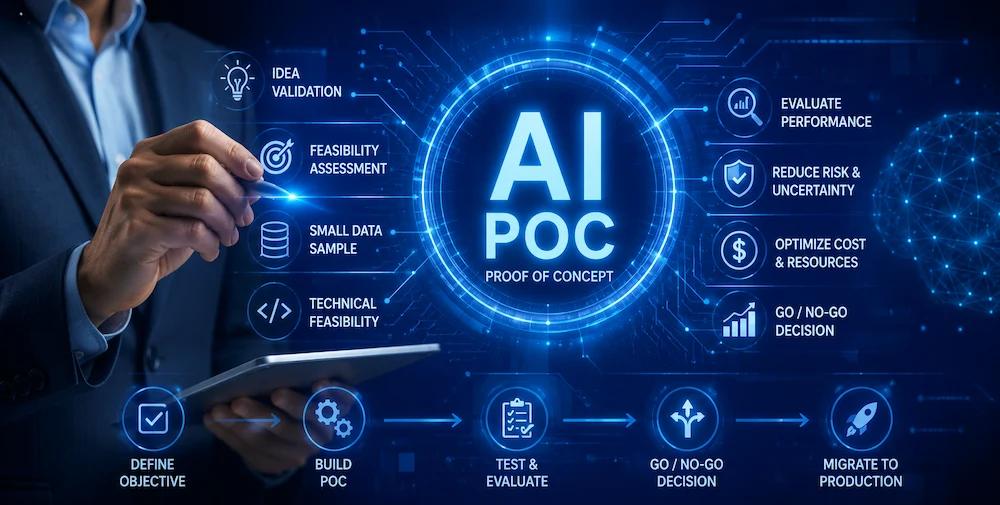
Most enterprise AI projects don't fail in production. They fail long before in the planning stage, when organizations commit large budgets to AI ideas that were never validated against real business data, real infrastructure, and real user workflows.
A structured AI proof of concept changes that. It's the fastest, lowest-risk way to find out whether your AI idea will actually work before you spend $500K on a full build that delivers the wrong thing.
This guide covers what an AI POC is, what it delivers, how long it takes, what it costs, and the go/no-go criteria that determine whether your idea is ready for full investment.
What Is an AI Proof of Concept?
An AI proof of concept (POC) is a time-boxed, small-scale build that tests whether a specific AI use case is technically feasible and worth investing in at full scale. It is not a finished product. It is not a demo. It is a structured experiment designed to answer one question: does this AI idea work well enough on our data, in our environment, to justify the cost of building it properly?
A well-designed AI POC validates three things:
- Technical feasibility can the model perform the task accurately enough to be useful?
- Data readiness is the data available, clean, and structured well enough to support the use case?
- Business viability —does the expected ROI justify the cost of full deployment?
Without this validation, you are making a multi-hundred-thousand-dollar decision based on vendor demos and industry case studies — not your own data.
Why AI Projects Fail Without a POC
According to industry research, over 85% of AI projects fail to make it from concept to production. The most common reasons aren't technical they are strategic:
- The use case was selected based on what sounded impressive, not what the data could support
- Data quality issues were discovered mid-build, forcing expensive pivots
- The model worked in testing but failed under real operational conditions
- No success criteria were defined upfront, so "good enough" was never established
- The business case couldn't survive executive scrutiny because ROI was never modeled
Every one of these failures could have been caught in a 4–8 week AI proof of concept at a fraction of the cost of a failed full build.
What a Good AI POC Delivers
A properly structured AI POC is not just a prototype — it produces a set of specific deliverables your organization can use to make a confident build/no-build decision.
By the end of your AI POC, you should have:
Technical feasibility report model accuracy benchmarks against your defined success threshold, latency measurements, and an assessment of how performance holds up as data volume scales.
Data readiness findings a clear picture of what data you have, what quality issues exist, what gaps need to be filled before a full build, and how long that remediation will take.
Integration feasibility assessment confirmation (or flag) that the AI solution can connect to your existing systems: ERP, CRM, data warehouse, cloud platform, or legacy applications.
ROI model projected cost of full build vs. expected operational savings, efficiency gains, or revenue impact giving you a business case your CFO can evaluate.
Go/no-go recommendation a clear, evidence-based recommendation on whether to proceed, pause, or pivot, with the reasoning behind it.
Production roadmap if the POC is successful, a phased plan for moving to full deployment, including architecture decisions, resource requirements, and timeline estimates.
For organizations moving beyond validation, understanding what separates a prototype from production-grade AI can help teams evaluate the engineering, integration, governance, monitoring, and operational capabilities required for full deployment.
Looking to start an AI proof of concept? Intellectyx offers structured AI POC development services designed to validate your use case and deliver a production roadmap in 4–8 weeks.
How to Validate AI Product Ideas Before Full Development
The most common mistake organizations make is starting with the technology and working backwards to a use case. The right approach is the reverse.
Here is the framework Intellectyx uses across every AI POC engagement:
Step 1: Define the Business Problem, Not the Technology
Start with a specific operational problem that has a measurable impact. "We want to use AI" is not a use case. "Our invoice approval cycle takes 8.4 days and generates $47K in late payment fees every quarter" is a use case. The more specific the problem, the easier it is to define success criteria and measure POC performance.
Step 2: Assess Data Readiness Before Writing a Line of Code
Before any development begins, audit the data that will train and run the model. Answer: how much data do you have? How clean is it? Is it labeled? Is it accessible? Is it representative of the real operational scenarios the model will face? Poor data discovered at this stage takes days to address. Discovered mid-build, it takes months.
Step 3: Define Success Criteria Upfront
This is the step most teams skip—and the one that causes the most disputes at the end of an AI Proof of Concept. During the AI Discovery Workshop, define the minimum acceptable performance before building anything. For a document extraction model, that might be 94% accuracy. For a fraud detection model, it could be a false positive rate below 2%. Establishing these success criteria upfront ensures everyone is aligned. If the POC meets the agreed threshold, you can confidently move to production. If not, you know exactly what needs to be improved before making further investments.
Step 4: Build in a Controlled Environment
Run the POC against a representative sample of your real data — not synthetic or curated data that makes the model look better than it will perform in production. Use your actual systems for the integration tests. The closer the POC environment is to production, the more reliable its results will be.
Step 5: Measure Against Your Criteria and Decide
At the end of the POC period, compare results against the success criteria you defined in Step 3. The decision should be objective, not political. If the model hit the threshold, build. If it didn't, understand why — and whether the gap is closeable before committing more budget.
AI POC Timeline: What 4–8 Weeks Looks Like
Most enterprise AI proof of concepts are completed in 4–8 weeks. Here is what a typical engagement looks like week by week:
Weeks 1–2: Discovery and Data Assessment
Stakeholder workshops, use case definition, success criteria agreement, data audit, infrastructure review, and initial feasibility analysis.
Weeks 3–5: Prototype Development and Testing
Model selection, data pipeline setup, prototype build, initial accuracy benchmarking, and early integration tests with connected systems.
Weeks 6–7: Validation and Performance Testing
Full performance benchmarking against success criteria, edge case testing, security and governance review, and user feedback from a small pilot group.
Week 8: Go/No-Go Decision and Production Roadmap
Results presented against success criteria, ROI model finalized, go/no-go recommendation delivered, production roadmap drafted for approved initiatives.
The timeline extends toward 8–12 weeks when multiple use cases are evaluated in parallel or when significant data remediation is required before the model can be tested accurately.
How Much Does an AI Proof of Concept Cost?
Enterprise AI POC engagements typically range from $25,000 to $75,000, depending on:
- Number of use cases being validated
- Data complexity and quality of existing data infrastructure
- Number of system integrations required (ERP, CRM, legacy systems)
- Whether a GenAI/LLM component is involved vs. a traditional ML model
- Depth of governance and compliance requirements
To put that in context: a failed full AI deployment typically costs $300,000–$1M+ in engineering time, vendor costs, and opportunity cost. A $40,000 POC that prevents a failed $600,000 build is not an expense — it is risk management.
For organizations exploring AI strategy and roadmap planning before committing to a specific use case, Intellectyx offers combined strategy-plus-POC engagements that compress the discovery phase.
AI POC vs. AI Pilot vs. Full Production: What's the Difference?
| Stage | Environment | Scale | Primary Goal |
|---|---|---|---|
| AI Proof of Concept (POC) | Controlled, isolated environment | Small data sample | Validate technical feasibility |
| AI Pilot | Limited real-world deployment | Small group of users | Test performance under production-like conditions |
| Full Production Deployment | Live production environment | All users and enterprise-wide data | Deliver measurable business value at scale |
A POC answers: can this work? A pilot answers: does it work in practice? Full deployment answers: is it working at scale? Many organizations move from POC directly to full deployment, skipping the pilot — which is often fine if the POC was run against sufficiently realistic data and integration conditions. For teams that do run a structured pilot phase, following proven best practices for piloting AI projects significantly increases the chances of making it from AI pilot to production without costly rebuilds.
Generative AI Proof of Concept: Is It Different?
A generative AI proof of concept follows the same framework as a traditional AI POC but has a few additional validation requirements:
Prompt engineering quality for LLM-based applications, the quality of the prompt design significantly affects output quality. POC testing should include prompt iteration and regression testing.
Hallucination rate generative models can produce confident but incorrect outputs. The POC must measure hallucination frequency and test the guardrails that catch and block problematic outputs.
Latency under load LLM inference is slower than traditional ML. POC performance testing should simulate realistic concurrent usage, not single-user scenarios.
Cost per query LLM API costs scale with usage. The POC should model inference costs at full production volume to validate the business case holds up at scale.
Intellectyx builds custom AI agents and generative AI systems across financial services, manufacturing, and healthcare — each beginning with a structured POC phase before any full-scale development begins.
Go/No-Go Criteria: How to Know If Your AI Idea Is Ready for Production
The go/no-go decision at the end of a POC should be based on objective criteria, not enthusiasm or sunk cost. Here are the five criteria Intellectyx evaluates at the close of every AI proof of concept:
1. Model accuracy meets the defined threshold
The model performs at or above the minimum accuracy, precision, or recall level agreed at the start of the engagement measured against real production-representative data.
2. Processing speed fits operational requirements
The model processes inputs within the time constraints the business workflow requires. A document extraction model that takes 4 minutes per document is not viable if invoices need to be routed within 30 seconds.
3. Integration with existing systems is technically feasible
The POC demonstrated successful data exchange with the ERP, CRM, or data platform the production system needs to connect to without requiring a full infrastructure rebuild.
4. ROI projection justifies full deployment cost
The financial model shows that expected operational savings, revenue impact, or efficiency gains will cover the cost of full deployment within an acceptable payback period.
5. User adoption risk is manageable
The POC user group engaged with the system, found it useful, and surfaced no fundamental workflow conflicts that would prevent broader adoption.
If all five are met proceed. If one or two fall short understand why and determine whether the gap is addressable before committing. If three or more fail the use case needs to be redesigned or the data foundation needs significant work before any build investment makes sense.
How Consultants Assess AI Readiness in Businesses
Before recommending whether to run a POC, experienced AI consultants conduct a rapid readiness assessment covering four dimensions:
Data readiness volume, quality, labeling status, accessibility, and governance of the data that would train and run the proposed model.
Infrastructure readiness cloud platform maturity, API availability, integration capability with target systems, and MLOps tooling in place.
Organizational readiness internal AI expertise, change management capacity, executive sponsorship clarity, and governance frameworks for AI deployment.
Use case readiness specificity of the business problem, measurability of success, availability of ground truth data, and regulatory constraints on the proposed application.
Organizations that score high across all four dimensions can typically move into a POC immediately. Those with gaps in data or infrastructure readiness often benefit from a short remediation sprint before the POC begins — otherwise the POC will surface the data problems rather than validate the AI idea.
Start Your AI Proof of Concept with Intellectyx
Intellectyx delivers structured AI proof-of-concept engagements for financial services, manufacturing, healthcare, and enterprise operations teams. Every POC engagement includes use case discovery, data readiness assessment, prototype development, performance validation, and a go/no-go recommendation with a production roadmap.
Ready to validate your AI idea before committing full budget?
Or speak directly with our team about your specific use case: 👉 Schedule an AI POC Consultation →


![10 Leading Providers for Production-Grade AI Solutions [2026]](https://cdn.sanity.io/images/d7v5jzao/production/47f75d8ffc68c345a672b07452b2bc422c49909d-1000x667.webp)