Quick Answer
To hire an AI development team for retail automation, evaluate their retail experience, AI capabilities, data expertise, system integration skills, and ability to deliver scalable solutions. Start with a high-value use case such as inventory, customer service, or demand forecasting.
Introduction
Artificial intelligence is changing how retailers manage stores, interact with customers, forecast demand, and make operational decisions. From AI-powered recommendations and inventory forecasting to computer vision and intelligent customer service, retailers are moving beyond basic automation toward systems that can analyze information and support or execute business processes.
But implementing AI successfully is not simply a matter of adding an AI tool to a retail operation. Businesses need the right data, integrations, technology architecture, security, and expertise to turn AI capabilities into useful workflows.
That is why many organizations choose to hire an AI development team for retail automation rather than attempting to build every capability internally.
An experienced AI development team can identify high-value use cases, develop custom AI solutions, integrate them with existing retail systems, and help move projects from proof of concept to production.
This guide explores how AI is being used in retail stores, whether retail jobs are at risk, the most practical AI applications, what an AI development team can automate, and what retailers should consider before hiring an AI development partner.
How Is AI Used in Retail Stores?
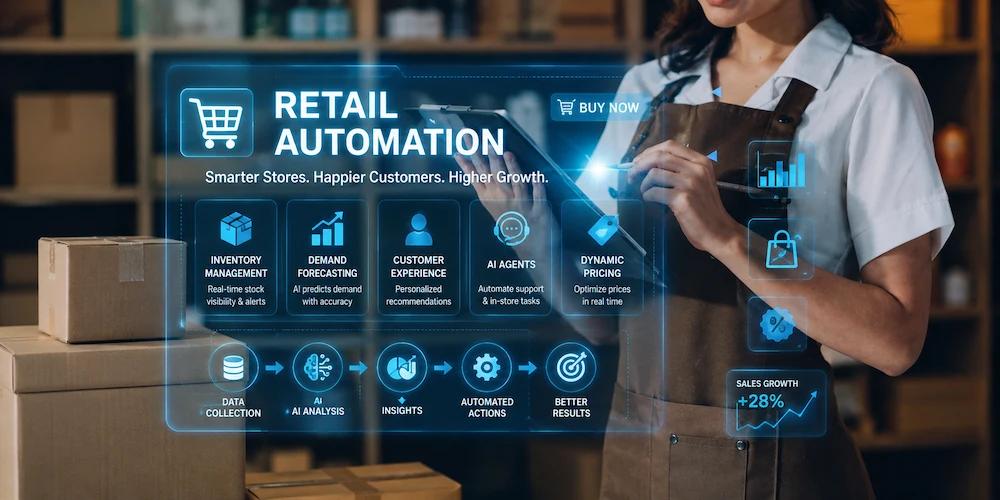
AI is used in retail stores to improve customer experiences, automate repetitive tasks, optimize inventory, analyze customer behavior, forecast demand, and support store employees.
Unlike traditional automation, which typically follows predefined rules, AI can analyze large amounts of data and identify patterns that can support more dynamic decision-making.
Some common applications include:
AI-Powered Product Recommendations
AI can analyze customer behavior, purchase history, browsing patterns, and product information to recommend relevant products.
For example, an e-commerce retailer can use AI to recommend products based on what a customer has previously viewed or purchased.
Inventory Monitoring
AI can help retailers monitor inventory levels and identify potential stockouts or excess inventory.
Computer vision can also be used to analyze shelves and identify issues such as:
- Empty shelves
- Incorrect product placement
- Missing products
- Low stock
- Planogram deviations
Demand Forecasting
AI can analyze historical sales, seasonality, promotions, customer behavior, and other factors to predict future product demand.
This can help retailers make better purchasing and replenishment decisions.
Customer Service
AI assistants and AI agents can answer common questions about:
- Product availability
- Store hours
- Orders
- Returns
- Shipping
- Product information
More advanced AI agents can connect with internal systems to retrieve information and support multi-step customer service workflows.
Personalized Marketing
Retailers can use AI to segment customers and personalize promotions, offers, emails, and product recommendations.
Workforce Optimization
AI can analyze store traffic, employee availability, historical demand, and business requirements to help optimize workforce scheduling.
What Are the Most Practical Uses of AI in Retail Today?
The most practical AI applications in retail are those that solve measurable operational or customer-experience problems rather than simply adding AI for the sake of using it.
Some of the strongest use cases include:
AI Use Case
What It Helps Retailers Do
- Demand Forecasting
- Predict future product demand
- Inventory Optimization
- Reduce overstock and stockouts
- AI Customer Service
- Automate repetitive customer interactions
- Product Recommendations
- Personalize shopping experiences
- Computer Vision
- Monitor shelves and store environments
- Dynamic Pricing
- Support pricing decisions
- Fraud Detection
- Identify suspicious transactions
- Marketing Personalization
- Deliver targeted offers
- Order Management
- Automate order-related workflows
- Workforce Optimization
- Improve staff scheduling
- AI Agents
- Execute multi-step retail workflows
- Predictive Analytics
- Support operational decisions
The best use case depends on the retailer's data, technology environment, business model, and objectives.
For example, an online retailer may prioritize recommendation engines and customer service automation, while a large physical retailer may prioritize inventory optimization, computer vision, demand forecasting, and workforce management.
Is Retail at Risk of AI?
Retail is not necessarily at risk because of AI, but retail jobs and workflows are likely to change as AI automation becomes more widespread.
AI is more likely to automate specific tasks than eliminate every role associated with those tasks.
For example, AI can automate repetitive activities such as:
- Answering routine customer questions
- Processing basic requests
- Generating product descriptions
- Analyzing inventory data
- Creating reports
- Identifying potential stock issues
- Scheduling recommendations
This can allow employees to spend more time on activities requiring human judgment, communication, problem-solving, and customer interaction.
The bigger question for retailers is therefore not:
"Will AI replace retail?"
but:
"Which retail tasks should AI automate, and where should humans remain involved?"
That distinction is important when designing retail AI systems.
Will Retail Workers Get Replaced by AI?
Some repetitive retail tasks may be automated by AI, but that does not mean AI will replace all retail workers. Instead, many retail roles are likely to evolve as employees work alongside AI-powered systems.
Consider a customer service employee.
Instead of manually answering every basic question, an AI assistant could handle routine requests while the employee handles complicated complaints, high-value customers, or situations requiring empathy and judgment.
Similarly, a store manager could use AI to analyze sales, inventory, staffing, and store-performance data rather than manually preparing reports.
This creates a human + AI operating model.
AI handles:
- Data analysis
- Repetitive queries
- Pattern detection
- Forecasting
- Routine workflows
- Recommendations
Humans handle:
- Complex decisions
- Customer relationships
- Leadership
- Negotiation
- Exception handling
- Creative problem-solving
- Strategic decisions
The goal of retail AI automation should therefore not always be replacing people.
In many cases, the greater opportunity is to augment employees and remove repetitive work.
Why Should Retailers Hire an AI Development Team for Automation?
Retailers should consider hiring an AI development team when they need customized AI solutions that connect with existing systems and automate complex workflows.
A specialized team can help with:
- AI strategy
- Use-case identification
- Data engineering
- Generative AI development
- AI agent development
- Machine learning
- Computer vision
- Enterprise integration
- Cloud deployment
- AI security
- Testing and monitoring
For example, a retailer might already have an ERP, POS, CRM, inventory platform, and e-commerce system.
The challenge isn't simply building an AI model.
The challenge is making the AI work with all of those systems.
That is where an experienced AI development team can provide value.
What Can an AI Development Team Automate in Retail?
An AI development team can automate customer-facing and operational workflows across the retail organization.
Customer Service Automation
AI can handle routine questions and assist customer service teams with more complex requests.
Inventory Automation
AI can monitor inventory, identify potential shortages, and generate replenishment recommendations.
Demand Forecasting
Machine learning models can analyze historical and real-time data to support demand predictions.
Order Management
AI can help monitor order status, identify exceptions, and communicate updates.
Marketing Automation
Generative AI and predictive models can support personalized campaigns and customer segmentation.
Store Operations
AI can assist with store monitoring, workforce scheduling, shelf analysis, and operational reporting.
Supply Chain Automation
AI can analyze supplier, inventory, logistics, and demand information to identify potential disruptions and recommend actions.
What AI Solutions Can Be Developed for Retail Automation?
Depending on the business requirements, an AI development team can build:
- AI agents for retail
- Generative AI applications
- Recommendation engines
- Demand forecasting systems
- Predictive analytics platforms
- Computer vision solutions
- Conversational AI
- Intelligent document processing
- Inventory optimization systems
- AI-powered business intelligence
- Multi-agent retail automation systems
The solution should always be tied to a measurable business objective.
Retailers that need agents configured for their specific workflows and integrations can explore custom AI agent development to understand how purpose-built retail agents are scoped, built, and deployed against production systems.
Instead of asking:
"Where can we add AI?"
retailers should ask:
"Which process is costing us the most time, money, or operational efficiency?"
That question usually produces better AI use cases.
How Do AI Agents Automate Retail Operations?
AI agents can automate retail operations by interpreting information, accessing connected systems, making decisions within defined parameters, and executing multi-step workflows.
For example, consider inventory replenishment.
A traditional process might require an employee to:
- Check inventory.
- Review sales.
- Analyze demand.
- Check supplier information.
- Determine the required quantity.
- Create a purchase request.
An AI agent could coordinate these steps across connected systems.
Inventory System → AI Agent → Demand Analysis → Supplier Data → Recommendation → ERP
AI agents can potentially support:
- Customer service
- Inventory management
- Order management
- Supplier communication
- Marketing
- Product recommendations
- Employee assistance
- Store operations
For more complex environments, multiple specialized AI agents can work together as a multi-agent system, with each agent responsible for a specific workflow.
What Are the Benefits of AI Automation in Retail?
The benefits depend on the use case, but common improvements include:
Reduced Manual Work
Employees spend less time performing repetitive tasks.
Faster Decisions
AI can analyze large volumes of data and surface relevant information quickly.
Improved Customer Experience
Personalized recommendations and faster customer support can improve interactions.
Better Inventory Management
AI can help identify demand patterns and potential inventory issues.
Increased Operational Efficiency
Automating repetitive processes can allow teams to focus on higher-value activities.
Scalability
AI systems can handle increasing volumes of data and customer interactions without requiring a proportional increase in manual effort.
How Much Does It Cost to Hire an AI Development Team for Retail Automation?
The cost of hiring an AI development team for retail automation depends on the complexity of the solution, AI models, data requirements, integrations, security requirements, and deployment scope.
A simple AI proof of concept will generally require less development effort than an enterprise solution connected to POS, ERP, CRM, inventory, e-commerce, and warehouse systems.
Key cost factors include:
- AI complexity
- Number of integrations
- Data preparation
- AI model selection
- Agent architecture
- Cloud infrastructure
- Security requirements
- User interface
- Testing
- Deployment
- Ongoing maintenance
For this reason, retailers should define the business problem first and then estimate the development requirements.
Starting with an AI proof of concept can also help validate business value before committing to a larger implementation.
How Long Does It Take to Build a Retail AI Automation Solution?
A focused retail AI proof of concept can take several weeks, while a production-grade enterprise AI automation solution may require several months.
The timeline depends on:
- Use-case complexity
- Data readiness
- Number of integrations
- AI architecture
- Security requirements
- Testing
- Deployment environment
A typical project may follow:
Discovery → Data Assessment → AI Strategy → POC → Development → Integration → Testing → Deployment → Monitoring
Starting with one high-value workflow is generally more practical than attempting to automate the entire retail operation at once.
What Should You Look for When Hiring an AI Development Team for Retail?
When you hire an AI development team for retail automation, don't evaluate the team only on its ability to build AI models.
Look for expertise in:
- AI and machine learning
- Generative AI
- AI agents
- Data engineering
- Computer vision
- Cloud computing
- API development
- ERP/POS/CRM integrations
- Retail workflows
- MLOps
- AI security and governance
Also ask potential partners:
Have you built AI solutions for similar workflows?
How will you integrate the AI with our existing systems?
How will you measure ROI?
What happens when the AI cannot confidently make a decision?
How will humans remain involved in the workflow?
Those questions can reveal whether a team understands enterprise AI implementation rather than simply AI development.
How to Start Retail AI Automation
A practical implementation approach is:
1. Identify high-value processes
Find repetitive, expensive, slow, or error-prone workflows.
2. Assess data readiness
Determine whether the necessary customer, sales, inventory, and operational data is available and reliable.
3. Prioritize use cases
Evaluate each opportunity based on business value, technical feasibility, data availability, and complexity.
4. Build a proof of concept
Start with one focused workflow. Knowing the difference between a proof of concept and a pilot helps retail teams set the right expectations for what gets validated at each stage before committing to full deployment.
5. Integrate existing systems
Connect the AI solution to relevant POS, ERP, CRM, e-commerce, inventory, or warehouse platforms.
6. Measure results
Track metrics such as:
- Cost savings
- Processing time
- Conversion rate
- Inventory efficiency
- Customer satisfaction
- Employee productivity
For a structured framework covering task completion rate, decision accuracy, workflow success, and governance benchmarks, see our guide to agentic AI evaluation metrics.
7. Scale
Once the initial use case demonstrates measurable value, expand AI automation into additional workflows.
Why Choose Intellectyx AI for Retail AI Development?
Intellectyx AI can help retailers move from AI experimentation to production-ready automation by combining AI development, data engineering, intelligent automation, and enterprise integration.
The focus should not simply be on deploying an AI model. Successful retail automation requires connecting AI with the data, systems, and workflows that employees and customers already use.
Solutions can include AI agents, generative AI applications, predictive analytics, intelligent automation, recommendation systems, and enterprise AI integrations designed around specific retail requirements.
Whether the objective is improving customer service, optimizing inventory, forecasting demand, automating workflows, or creating AI-powered retail operations, the implementation should begin with the business problem and work backward toward the appropriate technology.
![10 Leading Providers for Production-Grade AI Solutions [2026]](https://cdn.sanity.io/images/d7v5jzao/production/47f75d8ffc68c345a672b07452b2bc422c49909d-1000x667.webp)