
Quick Answer
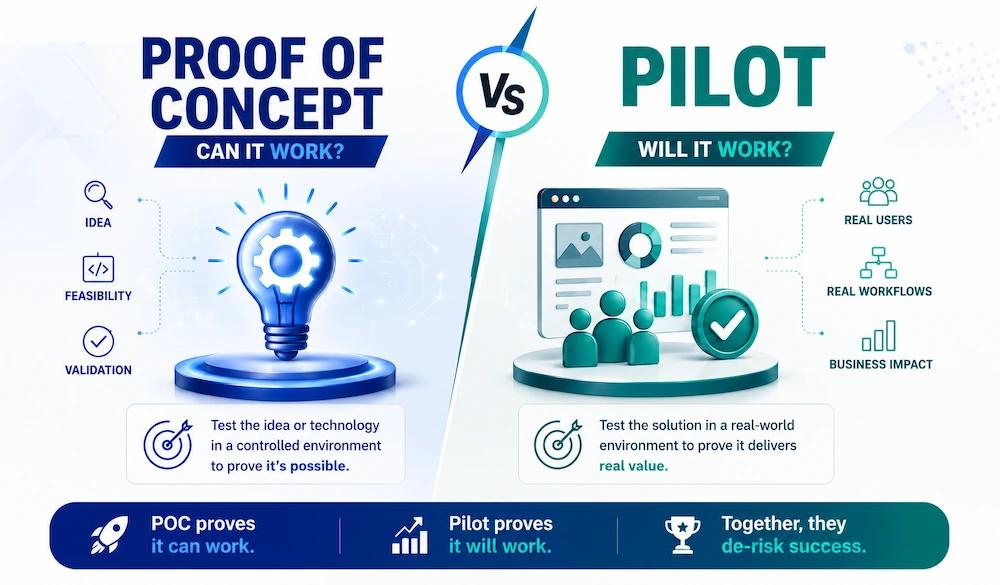
A proof of concept (POC) determines whether an AI solution is technically feasible, while a pilot tests whether that solution delivers value with real users, live data, and operational workflows. Use a POC to prove “Can it work?” and a pilot to answer “Does it work in our business?
Enterprise leaders evaluating AI initiatives face a critical decision early in the process: should they start with a proof of concept or move directly to a pilot program? Understanding the distinction between proof of concept vs pilot determines whether your AI investment delivers measurable business value or becomes another failed technology experiment.
The stakes are significant. According to industry research, approximately 85% of AI projects fail to move beyond experimental phases. Many of these failures trace back to misalignment between the validation approach and organizational readiness, technical complexity, or business objectives.
POC vs Pilot Explained
A proof of concept validates whether an AI solution can technically solve a specific problem under controlled conditions. A pilot tests whether that validated solution works effectively in real operational environments with actual users and live data. Choose a POC when you need to prove technical feasibility before committing resources. Choose a pilot when technical viability is established and you need to validate operational readiness, user adoption, and business impact at scale.
Quick Takeaways: Proof of Concept Vs Pilot for AI
- POC validates technical feasibility in a controlled environment over 4 to 8 weeks
- Pilots test operational viability with real users and production data over 3 to 6 months
- POC costs less upfront but provides limited business validation
- Pilots require more investment but generate actual performance metrics and ROI data
- Sequential approach works best: POC first, then pilot, then production deployment
- Skip POC only when using proven AI solutions with established track records in your industry
- Pilot failure is valuable because it exposes integration, adoption, and process issues before full rollout
Comparison Table: Proof of Concept Vs Pilot
| Dimension | Proof of Concept | Pilot Program |
|---|---|---|
| **Primary Goal** | Validate technical feasibility | Validate operational and business viability |
| **Duration** | 4 to 8 weeks | 3 to 6 months |
| **Environment** | Controlled, sandbox, synthetic data | Production environment with real data |
| **Users** | Technical team only | Actual end users and stakeholders |
| **Data** | Sample or synthetic datasets | Live production data |
| **Success Metrics** | Technical accuracy, model performance | Business KPIs, user adoption, ROI indicators |
| **Investment Level** | $25K to $100K typically | $100K to $500K typically |
| **Risk Exposure** | Low, contained to lab environment | Moderate, limited to pilot scope |
| **Output** | Technical validation report | Business case with measured outcomes |
| **Decision Point** | Proceed to pilot or abandon | Proceed to full deployment or iterate |
What Is an AI Proof of Concept and When Should You Use One?
An AI proof of concept is a focused technical validation exercise that demonstrates whether a proposed AI solution can solve a specific problem within defined constraints. The POC answers one fundamental question: can this technology actually do what we need it to do?
Organizations beginning their AI journey benefit from understanding the AI proof of concept guide that outlines structured validation approaches.
Technical Validation Focus
POCs concentrate on core technical capabilities. For a fraud detection AI agent, this means testing whether the model can accurately identify fraudulent transactions in historical data. For a predictive maintenance system, it means validating whether sensor data patterns reliably predict equipment failures.
The controlled environment allows teams to isolate variables, adjust parameters, and iterate rapidly without risking production operations.
Ideal Scenarios for POC
- Novel AI applications where similar implementations have not been proven in your industry
- Complex technical requirements involving multiple AI models or integration points
- High uncertainty about data quality, availability, or model feasibility
- Stakeholder skepticism requiring concrete evidence before budget approval
- Regulatory considerations demanding documented technical validation
POC Limitations
The controlled nature of POCs creates inherent blind spots. Synthetic data behaves differently than production data with its inconsistencies, edge cases, and volume variations. Technical teams using the system cannot reveal adoption challenges that emerge when frontline employees interact with AI tools. Lab conditions cannot replicate the integration complexity of enterprise technology ecosystems.
These limitations explain why successful POCs sometimes fail during operational deployment.
What Is an AI Pilot Program and How Does It Differ?
An AI pilot program tests a technically validated solution in real operational conditions with actual users, live data, and production system integrations. Pilots answer the question: does this solution work effectively in our actual business environment?
Operational Validation Focus
Pilots expose solutions to complexity that POCs cannot simulate. Real users interact with AI tools differently than technical teams. Production data contains anomalies, gaps, and patterns absent from curated test datasets. Legacy system integrations reveal latency, compatibility, and data flow challenges.
A manufacturing company piloting AI agents for predictive maintenance might discover that floor supervisors need different alert thresholds than maintenance technicians, or that cellular connectivity on the plant floor creates intermittent data gaps.
Ideal Scenarios for Pilot Programs
- Proven AI technologies with established track records in similar applications
- Clear technical feasibility based on vendor demonstrations or prior POC
- User adoption concerns requiring real world testing before broad rollout
- Process integration complexity involving multiple departments or workflows
- ROI validation needs demanding measured business outcomes for investment justification
Pilot Program Structure
Effective pilots define clear boundaries. This includes selecting a specific business unit, geographic location, or product line as the pilot scope. Success metrics align with business objectives rather than technical performance alone.
A financial services firm piloting a loan underwriting AI agent might measure time to decision, underwriter productivity, approval rate accuracy, and customer satisfaction alongside model accuracy metrics.
Key Factors for Choosing Between Proof of Concept Vs Pilot
The decision between POC and pilot depends on several organizational and technical factors that vary by situation.
Technical Maturity Assessment
Evaluate whether the AI capability you need is emerging, maturing, or established. Generative AI applications for content creation have moved from experimental to operational in many industries. Computer vision for quality inspection has decades of refinement. Novel applications combining multiple AI modalities remain less proven.
Emerging capabilities warrant POC validation. Established capabilities with strong vendor track records may skip directly to pilots.
Data Readiness Evaluation
AI solutions depend on data quality, availability, and accessibility. If your organization lacks confidence in data infrastructure, a POC exposes data issues before significant investment. If data pipelines are mature and well documented, pilots can proceed with lower risk.
Manufacturing companies implementing supply chain planning AI agents often discover data fragmentation across ERP systems, supplier portals, and logistics platforms during POC phases.
Ready to Validate Your AI Initiative?
Schedule a ConsultationOrganizational Change Readiness
AI implementation involves people, not just technology. If your organization has limited experience with AI adoption, pilots reveal change management requirements early. If previous AI rollouts have established adoption playbooks, you can apply lessons learned to new pilots.
Investment Scale Alignment
POCs enable validation at lower cost before committing to pilot budgets. For AI applications requiring significant integration work or custom development, this staged approach reduces risk. For solutions available as configured SaaS platforms, pilot testing may provide faster path to value.
How to Structure a Successful AI Proof of Concept
A well-designed POC maximizes learning while minimizing time and resource investment.
Define Specific Technical Hypotheses
Vague goals produce vague results. Instead of "test whether AI can improve customer service," define specific hypotheses: "AI can accurately classify customer inquiries into 12 routing categories with 90% accuracy using existing ticket data."
Establish Clear Success Criteria
Quantify what success looks like before beginning. Technical accuracy thresholds, processing speed requirements, and integration feasibility criteria should be documented and agreed upon by stakeholders.
Use Representative Data
Sample data should reflect production data characteristics including volume, variety, quality issues, and edge cases. Curated datasets that exclude problematic records create unrealistic expectations.
Organizations exploring custom AI agents development should ensure POC testing uses data that represents actual operational complexity.
Document Learnings Systematically
POC value extends beyond binary pass or fail outcomes. Document technical constraints discovered, data quality issues identified, integration requirements clarified, and alternative approaches considered.
Timeline Example
- Week 1 to 2: Problem definition, data assessment, environment setup
- Week 3 to 5: Model development, training, initial testing
- Week 6 to 7: Iteration based on results, edge case testing
- Week 8: Documentation, stakeholder presentation, pilot recommendations
How to Design an Effective AI Pilot Program
Pilot programs require more structured planning than POCs because they involve production systems and real users.
Select Appropriate Pilot Scope
Choose a pilot scope that is representative enough to validate the solution but contained enough to manage risk. A single distribution center, one product line, or specific customer segment can provide meaningful data while limiting exposure.
Engage End Users Early
Pilots succeed when end users understand objectives, receive adequate training, and have channels for feedback. Resistance often stems from inadequate communication rather than solution deficiencies.
Implement Measurement Infrastructure
Before pilot launch, ensure you can capture the metrics needed to evaluate success. This may require instrumentation, reporting development, or baseline measurement collection.
Companies implementing AI agents need measurement systems that capture both technical performance and business outcome metrics.
Plan for Iteration
Pilots rarely succeed perfectly on initial launch. Build time for adjustments based on early feedback. Weekly review cycles allow teams to address issues before they undermine pilot success.
Define Escalation Thresholds
Establish criteria for pausing or terminating pilots if critical issues emerge. This prevents continued investment in failing approaches while protecting production operations.
Real World Examples: POC and Pilot in Action
Practical examples illustrate how organizations apply proof of concept vs pilot approaches effectively.
Manufacturing: Quality Control Implementation
A precision components manufacturer wanted to implement AI-powered visual inspection. Their proof of concept approach tested whether computer vision models could detect the specific defect types relevant to their products using historical inspection images.
The POC validated 94% detection accuracy for major defect categories but revealed that lighting variations on the production floor would require additional camera infrastructure. This finding shaped the pilot design.
The subsequent pilot deployed the solution on one production line with modified lighting. Over four months, the team validated defect detection in real time conditions, measured false positive rates, and documented inspector workflow integration requirements.
Financial Services: Fraud Detection Scaling
A regional bank implementing fraud detection AI leveraged vendor solutions with proven track records, bypassing POC in favor of direct pilot deployment. The fraud detection AI agent had demonstrated effectiveness at similar institutions.
The pilot focused on operational integration: how alerts would reach fraud analysts, what investigation workflows needed modification, and how the system would interact with existing case management tools.
Pilot results revealed that alert volume required adjusting sensitivity thresholds and that analyst training needed expansion beyond initial plans. These insights informed full deployment strategy.
Industry Applications for POC and Pilot Approaches
Different industries emphasize different validation priorities based on their AI maturity, regulatory requirements, and operational characteristics.
Manufacturing
Start Your AI Implementation Journey
Talk to Our ExpertsManufacturing AI applications often require POC validation because physical world integration creates unique technical challenges. Sensor reliability, environmental conditions, and equipment variability require testing before production deployment. Manufacturing AI agents demand rigorous validation given safety and quality implications.
Financial Services
Regulatory requirements in financial services often mandate documented validation processes. POCs provide technical evidence for compliance teams. Pilots demonstrate operational controls and audit capabilities. Finance AI agents require validation approaches that satisfy both technical and regulatory requirements.
Healthcare
Patient safety concerns elevate validation requirements in healthcare AI applications. POCs must demonstrate clinical accuracy. Pilots must validate workflow integration, clinician acceptance, and patient experience impacts under actual care delivery conditions.
Media and Entertainment
Content and audience analytics AI often benefit from pilot-first approaches because solutions are less safety critical and business impact can be measured quickly. AI agents for media and entertainment can often proceed to pilots based on vendor demonstrations.
Buyer Journey Insights: Aligning Validation with Decision Making
Organizations at different stages of AI maturity approach validation differently.
Early Stage Exploration
Companies exploring AI for the first time need POCs to build organizational confidence and technical understanding. The learning value of POCs extends beyond the specific use case tested.
Expansion Stage
Organizations with successful AI implementations in one area often skip POCs when extending to new use cases with similar technical characteristics. Pilots validate business fit rather than technical feasibility.
Optimization Stage
Mature AI adopters focus on pilot efficiency, compressing timelines and applying established playbooks. Their validation emphasis shifts toward business outcome measurement and change management effectiveness.
Engaging experienced partners for agentic AI strategy helps organizations match validation approaches to their maturity level.
Common Mistakes in POC and Pilot Implementation
Avoiding common pitfalls increases validation success rates.
POC Mistakes
- Scope creep: Adding features beyond initial technical validation goals
- Perfect data syndrome: Using cleansed data that misrepresents production conditions
- Technical isolation: Excluding integration testing that will be required for pilots
- Stakeholder exclusion: Running POCs without business stakeholder input on success criteria
Pilot Mistakes
- Inadequate baseline: Failing to measure pre-pilot performance for comparison
- Insufficient duration: Ending pilots before capturing enough data for confident decisions
- Change management neglect: Focusing on technology while underinvesting in user adoption
- Success theater: Declaring success based on selective metrics while ignoring challenges
Conclusion: Making the Right Choice Between Proof of Concept Vs Pilot
The proof of concept vs pilot decision shapes AI implementation success. POCs validate technical feasibility in controlled conditions. Pilots validate operational effectiveness in real environments. Most enterprise AI initiatives benefit from sequential application of both approaches.
Start with a POC when technical uncertainty exists, data readiness is unclear, or stakeholders need evidence before committing resources. Proceed to pilots when technical viability is established, and the focus shifts to operational integration, user adoption, and business outcome measurement.
Organizations that match their validation approach to their actual uncertainty reduce AI implementation risk while accelerating time to value. The structured progression from POC to pilot to production deployment remains the most reliable path to AI success in enterprise environments.
![10 Leading Providers for Production-Grade AI Solutions [2026]](https://cdn.sanity.io/images/d7v5jzao/production/47f75d8ffc68c345a672b07452b2bc422c49909d-1000x667.webp)