
Introduction
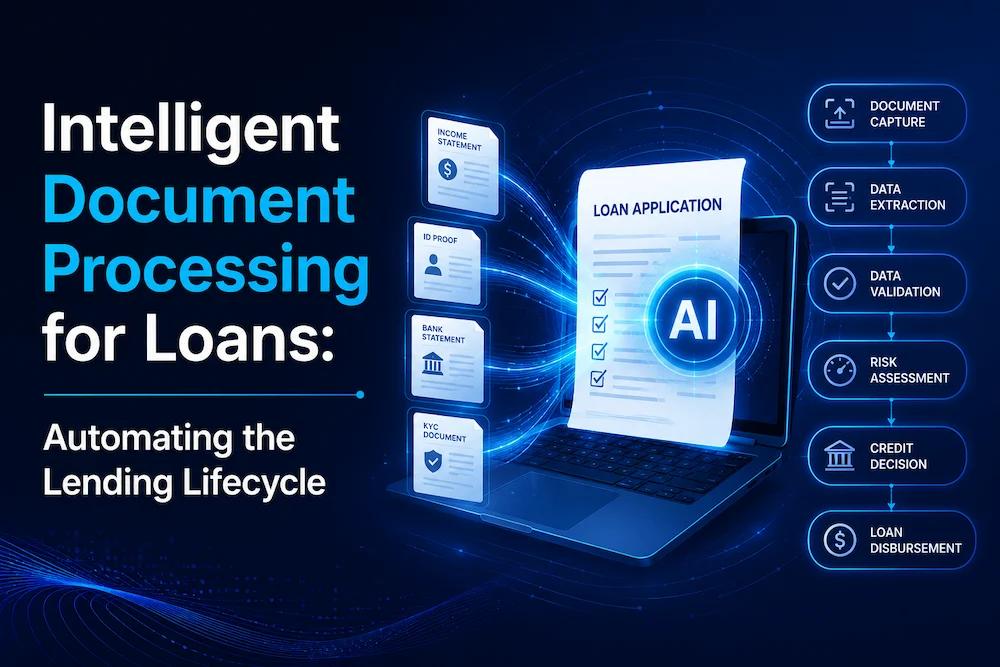
The lending industry processes billions of documents annually from income verification statements and tax returns to credit reports and property appraisals. Traditional manual review creates bottlenecks that frustrate borrowers, increase operational costs, and expose institutions to compliance risks. Intelligent Document Processing for Loans represents a fundamental shift in how financial institutions handle the document-intensive lending lifecycle, combining AI-powered extraction, validation, and decision support into unified workflows.
According to McKinsey, financial institutions that implement intelligent automation in lending operations reduce processing times by 50-70% while simultaneously improving accuracy rates. For lenders competing in an environment where borrower expectations demand near-instant decisions, this capability has become essential rather than optional.
This comprehensive guide examines how intelligent document processing transforms every stage of the lending lifecycle from initial application through servicing while delivering measurable improvements in efficiency, compliance, and customer experience.
What Is Intelligent Document Processing for Loans?
Intelligent Document Processing (IDP) for loans is an AI-powered technology that automatically extracts, classifies, validates, and processes loan-related documents without manual intervention. It combines machine learning, natural language processing, optical character recognition, and robotic process automation to transform unstructured documents into actionable lending decisions.
Unlike basic OCR solutions that simply digitize text, IDP systems understand document context, identify data relationships, and validate information against external sources. This intelligence enables automated handling of complex loan documents including:
- Pay stubs, W-2s, and tax returns for income verification
- Bank statements for asset validation
- Title documents and property appraisals
- Identity documents for KYC compliance
- Business financials for commercial lending
- Insurance certificates and flood determinations
Modern IDP platforms achieve 95%+ extraction accuracy on structured documents and 85%+ on semi-structured formats, enabling straight-through processing for qualified applications. Organizations implementing Finance AI Agents report dramatic reductions in manual document handling while maintaining rigorous compliance standards.
Quick Takeaways: Intelligent Document Processing for Lending
- 85% reduction in manual document review time across loan origination
- 50-70% faster loan processing from application to funding
- 99.2% accuracy in data extraction from standard lending documents
- 60% decrease in compliance exceptions and audit findings
- 40% improvement in borrower satisfaction scores
- $15-25 cost savings per loan file processed through automation
- 24/7 processing capability eliminates backlog during volume surges
How IDP Transforms the Lending Lifecycle
Intelligent document processing automates every document-dependent stage of lending from initial application intake through loan servicing creating seamless workflows that accelerate decisions while strengthening compliance.
Application Intake and Document Classification
The lending lifecycle begins when borrowers submit documentation. IDP systems automatically classify incoming documents regardless of format—scanned PDFs, mobile photos, email attachments, or fax transmissions. Machine learning models trained on millions of lending documents identify document types with 98%+ accuracy, routing each to appropriate extraction workflows.
This classification intelligence handles real-world complexity, including:
- Multi-page documents requiring separation
- Combined files needing individual processing
- Incorrect submissions requiring borrower notification
- Missing documents triggering automated requests
Data Extraction and Validation
Once classified, IDP extracts relevant data fields using context-aware AI models. For income verification, this means capturing employer name, pay frequency, gross earnings, deductions, and year-to-date totals from pay stubs—regardless of format variations across thousands of employers.
Critical validation occurs automatically:
| Validation Type | Automated Check | Exception Handling |
|---|---|---|
| Income Consistency | YTD amounts match calculated pay periods | Flag discrepancies for review |
| Employment Verification | Employer details match application data | Request clarification |
| Asset Verification | Account ownership matches borrower identity | Escalate potential fraud |
| Property Valuation | Appraisal within acceptable variance | Trigger additional review |
| Compliance Documents | Required disclosures present and signed | Block progression until resolved |
This validation layer catches errors that human reviewers frequently miss during high-volume processing periods. The Loan Underwriting AI Agent capabilities enable institutions to process validated data directly into underwriting decisions.
Decision Support and Underwriting
Validated document data flows directly into underwriting engines, eliminating re-keying errors and enabling faster credit decisions. IDP systems calculate debt-to-income ratios, verify asset reserves, and confirm employment stability surfacing only exceptions requiring human judgment.
For conforming loans meeting standard criteria, this enables touchless processing where applications progress from submission to approval without manual intervention. One regional credit union achieved 67% straight-through processing for consumer loans within six months of implementing IDP.
Closing and Funding
Closing document preparation and review represents another automation opportunity. IDP validates that all required disclosures match loan terms, ensures proper execution of documents, and confirms compliance with regulatory timing requirements.
Post-closing quality control audits—traditionally requiring manual file review—become automated verification processes that flag exceptions instantly rather than weeks after funding.
Comparison: Traditional vs. AI-Powered Loan Document Processing
AI-powered document processing delivers 5-10x efficiency improvements over manual methods while simultaneously improving accuracy and compliance outcomes.
| Capability | Traditional Manual Processing | Intelligent Document Processing |
|---|---|---|
| Document Classification | Manual sorting, 5-10 minutes per file | Automated, under 5 seconds |
| Data Extraction | Manual data entry, 20-45 minutes | Automated extraction, 30-60 seconds |
| Accuracy Rate | 85-92% (human error rate) | 95-99.2% (AI with validation) |
| Processing Capacity | 15-25 files per processor daily | 500+ files daily per system |
| Compliance Validation | Checklist-based, inconsistent | Rules-based, consistent enforcement |
| Exception Handling | Queue-based delays | Real-time routing and notification |
| Audit Trail | Manual documentation | Automated, immutable logging |
| Scalability | Linear with headcount | Elastic with demand |
| Operating Hours | Business hours only | 24/7/365 availability |
| Cost Per File | $25-40 average | $5-15 average |
These efficiency gains compound across high-volume lending operations. A mortgage lender processing 5,000 loans monthly saves approximately $100,000-175,000 in direct processing costs while simultaneously reducing turn times that impact pull-through rates.
Key Technologies Powering Loan Document Automation
Modern loan document automation combines five core AI technologies OCR, NLP, machine learning, computer vision, and robotic process automation to achieve human-level understanding of complex lending documents.
Optical Character Recognition (OCR)
Advanced OCR engines convert document images into machine-readable text with 99%+ character accuracy on typed documents. Modern systems handle handwritten entries, stamps, and signatures that challenged earlier OCR generations.
Natural Language Processing (NLP)
NLP enables understanding of document context rather than simple text extraction. When processing a bank statement, NLP identifies which transactions represent recurring income versus one-time deposits—intelligence critical for accurate underwriting.
Machine Learning Classification
Accelerate Your Lending Operations
Schedule a ConsultationML models trained on lending-specific document corpora classify documents and extract fields with continuously improving accuracy. These models adapt to new document formats without manual rule creation.
Computer Vision
Computer vision capabilities validate document authenticity, detecting alterations, inconsistent fonts, and other manipulation indicators. This technology supports fraud detection workflows that protect lenders from document fraud schemes.
Robotic Process Automation (RPA)
RPA handles system integration, moving extracted data into loan origination systems, credit platforms, and compliance databases without API dependencies. This accelerates implementation while ensuring data consistency across systems.
Use Cases: IDP Across Lending Products
Intelligent document processing delivers value across all lending product types, with implementation approaches tailored to each product's unique document requirements and regulatory environment.
Residential Mortgage Processing
Mortgage origination involves the highest document volumes in consumer lending typically 150-300 pages per file. IDP automates income calculation from tax returns, verification of employment, asset validation from bank statements, and title document review.
One national mortgage lender reduced file processing time from 12 days to 4 days while maintaining investor audit compliance rates above 99%.
Consumer and Auto Lending
Consumer loan applications require faster decisions with lighter documentation requirements. IDP enables same-day processing by automating income verification, identity validation, and payoff quote processing for refinance transactions.
Commercial and Small Business Lending
Business lending documents—financial statements, tax returns, entity documentation present unique complexity. IDP systems trained on commercial lending documents extract key ratios, validate entity structures, and identify documentation gaps that delay approvals.
Home Equity and Lines of Credit
HELOC processing benefits from IDP's ability to validate existing lien positions, process title documents, and verify property values against automated valuation models.
Organizations seeking comprehensive lending automation explore Custom AI Agents Development to build solutions addressing their specific product mix and compliance requirements.
Industry Applications: Financial Services Transformation
Financial institutions across segments from community banks to national lenders implement intelligent document processing to address competitive pressures, compliance demands, and borrower experience expectations.
Regional and Community Banks
AI Agents for Banking Customer Service enable smaller financial institutions to deliver fast, personalized support without significantly increasing staffing costs. Combined with Intelligent Document Processing (IDP), banks can automate customer requests, document verification, account servicing, and loan-related inquiries while providing real-time responses across web, mobile, and phone channels. A community bank with 50 branches achieved processing parity with larger regional competitors by strategically deploying AI automation and customer service agents, improving response times, operational efficiency, and overall customer experience.
Credit Unions
Member service expectations drive credit union IDP adoption. Automated document processing enables loan officers to focus on member relationships rather than administrative tasks.
Mortgage Lenders and Servicers
Volume sensitivity makes IDP essential for mortgage operations. The ability to scale processing during purchase season peaks without temporary staffing delivers both cost savings and quality consistency.
Fintech Lenders
Digital-first lenders build IDP into their core platforms from inception. This automation enables the near-instant decisions that define their competitive differentiation.
The Banking & Financial Services Case Study demonstrates measurable outcomes achieved through strategic AI implementation in lending operations.
Accelerate Your Lending Operations
Transform document-intensive lending workflows with intelligent automation that reduces processing time by 70% while strengthening compliance. Our lending AI specialists help financial institutions implement IDP solutions, delivering measurable ROI within 90 days.
Implementation Roadmap: Deploying IDP for Lending
Successful IDP implementation follows a phased approach—starting with high-volume document types, validating accuracy, then expanding automation across the lending lifecycle.
Phase 1: Assessment and Document Analysis (Weeks 1-4)
Begin by cataloging document types, volumes, and current processing costs. Identify high-impact automation candidates based on volume, complexity, and error frequency. Most lenders start with income documents (pay stubs, W-2s) due to standardized formats and high volumes.
Phase 2: Pilot Implementation (Weeks 5-12)
Deploy IDP for selected document types in parallel with existing processes. Measure extraction accuracy against manual processing, refine ML models, and establish confidence thresholds for automated vs. human review routing.
Phase 3: Production Rollout (Weeks 13-20)
Transition validated document types to production processing. Implement exception handling workflows, establish quality monitoring dashboards, and train operations teams on new processes.
Phase 4: Expansion and Optimization (Ongoing)
Extend automation to additional document types based on pilot learnings. Continuously improve extraction accuracy through model retraining and expand integration with downstream systems.
Organizations benefit from Agentic AI Strategy consulting to design implementation roadmaps aligned with their specific lending operations and technology environments.
Compliance and Risk Management Benefits
IDP strengthens regulatory compliance through consistent rule application, comprehensive audit trails, and automated exception detection that manual processes cannot match.
Transform Your Lending Document Workflows
Talk to an ExpertRegulatory Consistency
Automated validation ensures every loan file receives identical compliance review eliminating the inconsistency inherent in manual processes. TRID timing requirements, ability-to-repay calculations, and fair lending documentation occur systematically.
Audit Trail Documentation
Every document processed, field extracted, and validation performed generates immutable audit records. Examiners access complete processing histories that demonstrate compliance program effectiveness.
Exception Management
Real-time exception identification enables immediate resolution rather than post-close discoveries. Compliance teams focus on genuine risk issues rather than administrative corrections.
Anti-Money Laundering Support
Document verification supports AML compliance by validating identity documents, verifying source of funds documentation, and flagging inconsistencies requiring enhanced due diligence. Integration with AML Monitoring & Alert Triage capabilities creates comprehensive compliance coverage.
Buyer Journey Insights: Selecting IDP Solutions
Financial institutions evaluating intelligent document processing should assess vendor capabilities across accuracy, integration flexibility, compliance features, and lending-specific expertise.
Evaluation Criteria
| Criterion | Key Questions | Importance |
|---|---|---|
| Extraction Accuracy | What accuracy rates on lending documents? | Critical |
| Document Coverage | Which lending document types supported? | High |
| Integration Options | LOS, core banking, compliance system connectivity? | High |
| Compliance Features | Audit trails, regulatory reporting, TRID support? | Critical |
| Implementation Timeline | Time to production deployment? | Medium |
| Scalability | Volume handling during peak periods? | High |
| Total Cost of Ownership | Licensing, implementation, ongoing support? | High |
Decision-Making Stakeholders
IDP purchasing decisions typically involve:
- Operations Leadership: Efficiency gains and capacity planning
- Technology Teams: Integration requirements and security
- Compliance Officers: Regulatory adherence and audit support
- Finance: ROI analysis and budget approval
- Executive Sponsors: Strategic alignment and competitive positioning
ROI Calculation Framework
Calculate expected returns using:
- Current processing costs per loan file
- Volume of loans processed annually
- Expected efficiency gains (typically 50-70%)
- Compliance cost avoidance from reduced exceptions
- Customer experience improvements affecting pull-through
Most lenders achieve positive ROI within 6-12 months of full deployment.
Join leading financial institutions using intelligent document processing to deliver faster decisions, stronger compliance, and superior borrower experiences. Speak with our lending automation experts about your specific requirements.
Conclusion
Intelligent Document Processing for Loans represents essential infrastructure for competitive lending operations. By automating document classification, extraction, validation, and integration across the lending lifecycle, financial institutions achieve dramatic efficiency improvements while strengthening compliance and borrower experience.
The technology has matured beyond early-stage experimentation. Leading lenders now process the majority of loan documents without manual intervention, reserving human expertise for genuine exceptions and relationship management. Organizations that delay adoption face growing competitive disadvantages as borrower expectations for digital experiences intensify.
Success requires thoughtful implementation starting with high-impact document types, validating accuracy against manual processes, and progressively expanding automation scope. Financial institutions partnering with experienced implementation teams accelerate time-to-value while avoiding common deployment pitfalls.
The lending institutions thriving in today's environment share a common characteristic: they view intelligent document processing not as a technology project but as a fundamental operating model transformation. Those that embrace this shift position themselves for sustained competitive advantage in an increasingly automated financial services landscape.