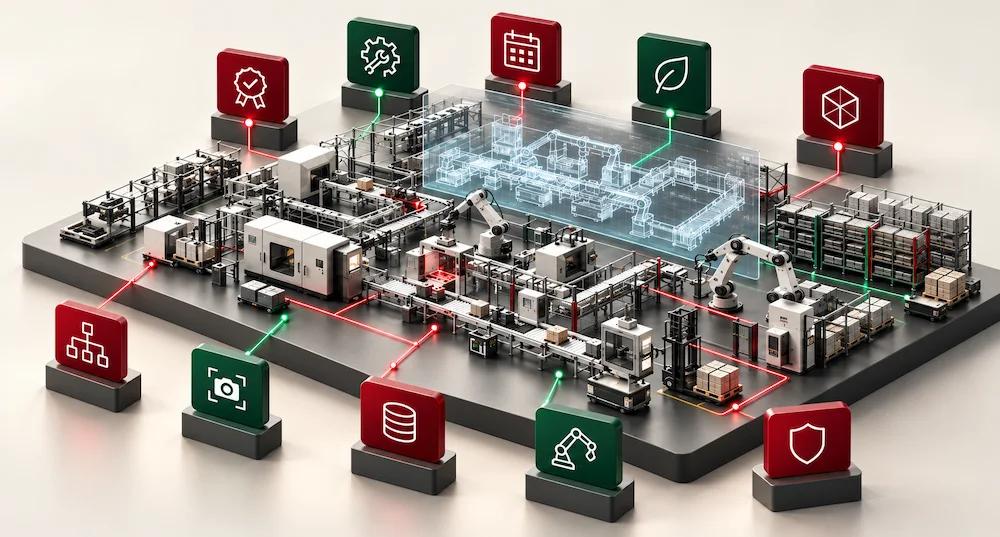
AI-driven quality assurance for electronic components uses machine learning, computer vision, and data analytics to detect defects, improve inspection accuracy, and automate quality control processes. AI in Electronics Manufacturing enables manufacturers to reduce errors, increase production efficiency, and ensure high reliability in electronic products.
This guide focuses specifically on electronic components; for a broader manufacturing perspective, see our complete AI defect detection guide covering visual inspection across all production environments.
Why AI is Transforming Quality Assurance in Electronics
Traditional quality assurance in electronics manufacturing relies heavily on manual inspection and rule-based testing systems, which are often slow, inconsistent, and susceptible to human error. As electronic components become smaller, more complex, and increasingly sensitive to defects, these traditional approaches struggle to maintain accuracy and efficiency at scale. Automated Testing and Validation Using AI Agents addresses these challenges by leveraging machine learning, computer vision, and intelligent automation to detect defects, validate product performance, and continuously improve testing accuracy throughout the manufacturing process.
AI solves these challenges by:
- Detecting microscopic defects with high precision
- Automating inspection processes in real time
- Learning from historical defect data
- Improving consistency across production lines
This makes AI essential for high-volume, high-precision electronics manufacturing.
Key Technologies Behind AI-Driven Quality Assurance
1. Computer Vision
AI-powered vision systems analyze images and videos to detect:
- Surface defects
- Soldering issues
- Misaligned components
These systems operate faster and more accurately than manual inspection.
2. Machine Learning Models
Machine learning enables systems to:
- Identify patterns in defect data
- Predict potential quality issues
- Continuously improve detection accuracy
3. Deep Learning
Deep learning models enhance:
- Image recognition for complex defects
- Classification of component failures
- Automated anomaly detection
4. Predictive Analytics
AI analyzes production data to:
- Forecast defect trends
- Optimize manufacturing processes
- Prevent failures before they occur
Improve your electronics quality with AI-driven inspection.
Get StartedKey Use Cases of AI-Powered Electronic Component Traceability Solutions
1. Automated Visual Inspection
AI systems inspect circuit boards and components in real time, identifying defects such as cracks, scratches, or missing parts.
For PCB assembly lines, visual AI inspection for PCB assembly quality control can take this further by using computer vision and machine learning to identify missing or misaligned components, polarity errors, solder abnormalities, and other visible assembly defects while supporting faster defect classification and quality review.
2. Solder Joint Inspection
AI detects poor solder connections, bridging, and voids that can affect performance and reliability.
3. Defect Classification
AI automatically categorizes defects, enabling faster root-cause analysis and resolution.
4. Process Optimization
AI identifies inefficiencies in manufacturing workflows and suggests improvements to reduce defects.
5. Predictive Quality Control
AI predicts where defects are likely to occur and adjusts processes proactively.
Benefits of AI-Driven Quality Assurance
- Higher defect detection accuracy
- Reduced manual inspection costs
- Faster production cycles
- Improved product reliability
- Consistent quality across batches
When defective components reach the field, AI doesn't stop at detection: automated warranty claims processing agents can validate claim eligibility, route cases, and trigger replacements without manual intervention.
Comparison: Traditional vs AI-Driven Quality Assurance
| Aspect | Traditional QA | AI-Driven QA |
|---|---|---|
| Inspection Speed | Slow | Real-time |
| Accuracy | Variable | High |
| Scalability | Limited | Highly scalable |
| Cost Efficiency | Labor-intensive | Cost-effective |
| Adaptability | Low | High |
| Defect Detection | Manual inspection | Automated (AI vision) |
How does AI improve quality assurance in electronic components?
AI improves quality assurance by automating defect detection, analyzing production data, and predicting potential failures. It reduces human error, increases inspection speed, and ensures consistent quality across manufacturing processes. The impact of catching defects early goes beyond individual components — learn how defect detection improves overall manufacturing quality across high-volume production lines.
Challenges and Considerations
Data Availability
AI systems require large datasets to train effectively.
Integration with Existing Systems
Integrating AI with legacy manufacturing systems can be complex.
Initial Investment
Upfront costs for AI implementation may be high but they deliver long-term ROI.
Model Accuracy and Validation
AI models must be continuously validated to ensure reliable results.
Automate your quality assurance with intelligent AI systems.
Request DemoHow to Implement AI-Driven Quality Assurance
- Identify high-impact inspection areas
- Collect and label quality data
- Choose the right AI tools and platforms
- Integrate AI into production workflows
- Continuously monitor and improve models
Conclusion
AI-driven quality assurance is transforming electronics manufacturing by enabling faster, more accurate, and scalable quality control processes. As electronic components become more complex, adopting AI is no longer optional but essential for maintaining a competitive advantage and ensuring product reliability. Electronics manufacturers looking to extend AI beyond quality inspection can explore predictive maintenance for electronics manufacturers to prevent equipment failures that cause the very defects QA must catch.