
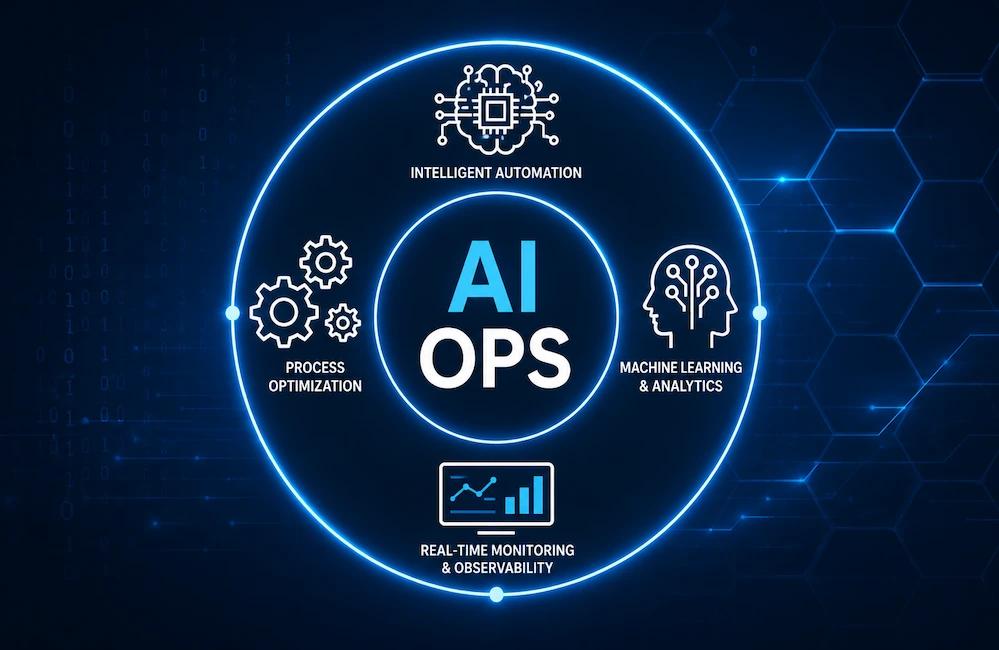
AIOps root cause analysis is the application of machine learning, causal inference, and topology-aware correlation algorithms to automatically identify the originating failure source of an IT incident - across logs, metrics, traces, and infrastructure events - faster and more accurately than human operators working from raw alert data. Where traditional root cause analysis relies on manual log review and tribal knowledge, AIOps compresses the mean time to identify (MTTI) from hours to minutes by correlating thousands of signals simultaneously, mapping failure propagation paths through the dependency graph, and surfacing the most probable root cause with supporting evidence ranked by confidence score.
Every minute of unplanned IT downtime costs money. For large enterprises, Gartner estimates average downtime costs of $5,600 per minute - and the majority of that cost accumulates not during the failure itself, but during the investigation. Teams sort through thousands of alerts, manually correlating logs across dozens of systems, and debating the root cause in war room calls while the outage continues.
AIOps root cause analysis attacks this problem directly. It replaces manual signal correlation with machine learning models that process the full observability data stream - metrics, logs, traces, events, topology - in real time, surfacing the most probable failure origin with evidence before the first human opens a terminal.
This article covers how it works, where it delivers the most impact, what it requires to deploy effectively, and what separates genuine AIOps root cause capability from alert correlation dressed up in AI language.
What Is AIOps Root Cause Analysis?
AIOps root cause analysis (RCA) is an AI-powered approach to incident management that automatically identifies the underlying cause of IT failures by analyzing patterns across the entire observability stack rather than requiring engineers to manually trace symptoms back to their source. Modern organizations are also adopting root cause analysis AI agent development solutions that continuously monitor infrastructure, correlate events, investigate anomalies, and surface probable root causes in real time.
Traditional root cause analysis in IT operations is largely reactive and manual. An alert fires, an engineer opens monitoring dashboards, reviews recent deployments, checks metrics, searches logs for error patterns, and eventually identifies the likely source of the issue. In complex cloud-native environments with hundreds of interconnected services, containers, APIs, and infrastructure components, this process can take hours.
AIOps RCA transforms this into an automated, near-real-time capability through four core technical mechanisms:
Anomaly detection across metrics and logs - ML models trained on historical operational data identify statistically significant deviations from normal behavior across thousands of metrics simultaneously, flagging anomalies that precede or accompany incidents before alert thresholds are crossed.
Service topology mapping and dependency analysis - AIOps platforms maintain a real-time dynamic map of service dependencies, infrastructure relationships, and data flows. When an incident occurs, the system can trace failure propagation backward through the dependency graph to identify whether a downstream symptom originates from an upstream root cause.
Event correlation and noise reduction - Enterprise environments generate thousands of alerts per hour during incidents. AIOps correlates related alerts into unified incident objects, suppresses noise (alerts that are symptoms of the root cause rather than independent issues), and surfaces the causal chain rather than the full alert flood.
Causal inference and ranked root cause hypotheses - The most advanced AIOps RCA systems use causal inference models - not just correlation - to distinguish between events that co-occur coincidentally and events that have genuine causal relationships. The output is a ranked list of root cause hypotheses, each with a confidence score and supporting evidence, enabling engineers to investigate the most probable cause first rather than beginning from zero.
Why Traditional Root Cause Analysis Fails at Scale
Traditional RCA approaches - manual log analysis, rule-based alert correlation, static runbooks - break down in three specific ways that AIOps directly addresses.
Alert fatigue eliminates signal value. Enterprise monitoring systems commonly generate thousands of alerts per day, with a significant percentage being duplicates, symptoms, or false positives. When every alert looks equally urgent, critical signals are buried in noise. Engineers develop alert fatigue and begin ignoring or auto-resolving alerts without investigation - exactly the behavior that causes incidents to escalate before intervention.
Tribal knowledge doesn't scale. In most organizations, root cause investigation relies on engineers who have worked on the system long enough to remember "last time this alert fired, it was because of service X" - knowledge that lives in human memory, is lost when engineers leave, and cannot be applied across all incidents simultaneously. AIOps encodes this knowledge as machine learning models that apply it at scale, to every incident, consistently.
Manual correlation cannot handle microservice complexity. A modern cloud-native application might have 200+ microservices, each generating independent metrics and logs. Manually correlating a downstream latency spike back through authentication → API gateway → cache layer → database → network to identify a misconfigured connection pool requires both system knowledge and time that most incident response windows do not allow. AIOps platforms perform this correlation automatically, across the full dependency graph, in seconds.
The 5 Core Capabilities of AIOps Root Cause Analysis
1. Predictive Anomaly Detection
AIOps platforms use time-series forecasting models (typically combinations of ARIMA, LSTM, and isolation forest algorithms) to establish dynamic baselines for each metric - CPU utilization, latency, error rate, throughput - and flag deviations that indicate developing failures before they cross hard alert thresholds.
The practical benefit is prediction before impact: AIOps surfaces leading indicators of failure (memory growth trending toward OOM, latency percentiles slowly degrading, connection pool exhaustion approaching threshold) early enough for preventive action, not just reactive response.
2. Topology-Aware Incident Correlation
When multiple services start throwing errors simultaneously, the critical question is: which service is the origin and which are downstream casualties? Topology-aware correlation uses the service dependency map to distinguish root causes from symptomatic failures - preventing the common scenario where engineers fix a symptom that immediately recurs because the upstream root cause was never addressed.
This capability is particularly valuable in AI-driven operational environments where automated workflows span multiple interconnected systems and a failure in one component can cascade across dozens of downstream processes simultaneously.
3. Log Intelligence and Pattern Recognition
Modern AIOps platforms apply NLP models to unstructured log data - identifying novel error patterns, clustering related log anomalies, and extracting structured signals from free-form text. This converts logs from a manual investigative resource into an automated signal source that contributes to root cause hypotheses.
Log intelligence also enables historical pattern matching: identifying that the current anomaly signature matches a pattern that caused an outage six months ago, surfacing the historical resolution steps as context for the current investigation.
4. Noise Reduction and Alert Grouping
A high-noise alert environment is as damaging as no alerting at all. AIOps RCA platforms use clustering algorithms to group related alerts into unified incident objects, suppress alerts that are downstream symptoms of an identified root cause, and reduce alert volume by 60–90% during active incidents - allowing engineers to focus on the signal that matters rather than triaging a thousand simultaneous notifications.
5. Automated Runbook Triggering and Remediation
The most advanced AIOps implementations close the loop between root cause identification and resolution through automated remediation - triggering runbook actions (service restarts, configuration rollbacks, traffic rerouting) based on high-confidence root cause identifications for known failure patterns. This converts AIOps RCA from a human-speed capability to a machine-speed capability for well-understood failure modes.
This level of autonomous operational response is the natural extension of the agentic AI architectures that Intellectyx deploys across enterprise operations. Understanding how agentic AI operates across enterprise workflows provides important context for what autonomous IT operations automation actually requires at the architectural level.
Is Alert noise slowing down your incident response?
Get FREE ConsultationHow AIOps Root Cause Analysis Reduces MTTR
Mean Time to Resolution (MTTR) - the average time from incident detection to service restoration - is the operational metric most directly impacted by AIOps RCA. Enterprises deploying production-grade AIOps consistently report MTTR reductions of 50–80%, driven by compressing three of the four phases of incident response:
Detection phase (MTTD): AIOps predictive anomaly detection identifies incidents earlier in their development, often before they impact end users. Organizations moving from reactive alerting to predictive AIOps typically reduce MTTD by 40–60%.
Identification phase (MTTI): Automated root cause identification replaces manual log triage and correlation. This is where the largest MTTR reduction occurs - compressing what a 30–90 minute manual investigation was to a 2–5 minute automated analysis with ranked hypotheses.
Remediation phase (MTTR-R): For known failure patterns with automated runbooks, AIOps can reduce remediation time from minutes to seconds through automated response. For novel failures requiring human intervention, AIOps provides engineers with precise, evidence-backed root cause identification that eliminates exploratory investigation and allows immediate remediation action.
The cumulative effect of these reductions transforms incident response from a reactive, high-cost, high-stress process into a structured, largely automated workflow - allowing engineering teams to focus on novel and complex failures rather than repeatedly diagnosing known patterns.
What AIOps Root Cause Analysis Requires to Work in Production
Deploying AIOps RCA as a genuinely effective production capability - rather than as a monitoring dashboard with ML marketing language applied - requires four prerequisites that most implementation guides understate.
Unified observability data. AIOps correlation and causal inference works on the relationship between metrics, logs, traces, and events across your entire infrastructure. If your observability data is siloed in separate tools with no common data model, AIOps cannot correlate signals across silos. Unified observability - a single data platform ingesting all telemetry types - is the infrastructure prerequisite for effective AIOps RCA.
Accurate service topology. Topology-aware correlation requires an accurate, dynamically updated map of service dependencies. Manually maintained CMDB data is typically too stale for AIOps topology mapping - you need auto-discovery that keeps the dependency map current as infrastructure changes. This is a harder infrastructure problem than it appears in most AIOps vendor demos.
Sufficient historical data for model training. Anomaly detection models need historical operational data to establish baselines and learn normal vs. abnormal behavior patterns. Most AIOps platforms require 4–8 weeks of historical observability data before anomaly detection achieves production-quality accuracy. Organizations with less history, or with highly seasonal/variable traffic patterns, should plan for an extended baselining period before AIOps RCA reaches its rated accuracy.
Integration with incident management workflows. AIOps root cause output has limited value if it is not surfaced within the workflow engineers use to manage incidents - ServiceNow, PagerDuty, Jira Service Management. Integration with incident management platforms ensures that AIOps-generated root cause hypotheses, evidence packets, and confidence scores are visible at the moment engineers need them, not in a separate tool they have to context-switch to.
AIOps Root Cause Analysis: Key Use Cases by Environment
Cloud-Native Microservices: AIOps RCA is most impactful in environments with many interdependent services, where manual failure tracing is prohibitively complex. Topology-aware correlation and causal inference provide the highest relative value here.
Hybrid Cloud Environments: Incidents that span on-premise and cloud infrastructure are particularly difficult to investigate manually because observability tools are often different on each side of the boundary. AIOps that ingests from both environments provides unified root cause analysis across the full hybrid topology.
AI and ML Operations (AgentOps): As enterprises deploy AI agents and ML models in production, those AI systems generate their own operational signals - model latency, inference error rates, data pipeline failures, agent task failures. AIOps principles applied to AI system operations - what Intellectyx calls AgentOps - bring the same root cause automation to AI infrastructure that traditional AIOps brings to application and infrastructure operations.
Manufacturing and Industrial IoT: Operational technology environments - SCADA systems, PLCs, industrial sensors - generate high-volume, high-velocity telemetry that far exceeds manual analysis capacity. AIOps RCA applied to industrial operations identifies equipment failure precursors and production system anomalies that would otherwise cause unplanned downtime.
Ready to automate root cause analysis with AI?
Talk to Our AI Operations TeamHow to Choose an AIOps Root Cause Analysis Platform
Evaluating AIOps RCA tools requires looking past the demo - where every platform performs well on curated data - and assessing production capability on the dimensions that actually determine operational value.
Causal inference vs. correlation: Ask vendors specifically whether their RCA engine uses causal inference (distinguishing causes from co-occurring symptoms) or correlation-only approaches. Correlation-only platforms surface related events; causal inference platforms identify which event caused the others. The difference in investigative value is significant.
Topology coverage: Verify that the platform's auto-discovery covers your full infrastructure scope - containers, serverless functions, cloud databases, network devices, and any custom applications. Gaps in topology coverage create gaps in root cause analysis.
Noise reduction track record: Request vendor references from organizations with comparable alert volume to yours and ask specifically about alert reduction ratios achieved in production.
Integration with your existing toolchain: AIOps platforms that require replacing your existing observability tools create adoption barriers that frequently defeat deployment. Platforms that ingest from existing tools (Datadog, Splunk, Prometheus, Dynatrace, Elastic) without requiring replacement are significantly easier to deploy.
For organizations evaluating AIOps alongside broader AI development investments, our guide to choosing the right AI development company provides a practical framework for vendor and partner assessment.