Quick Answer
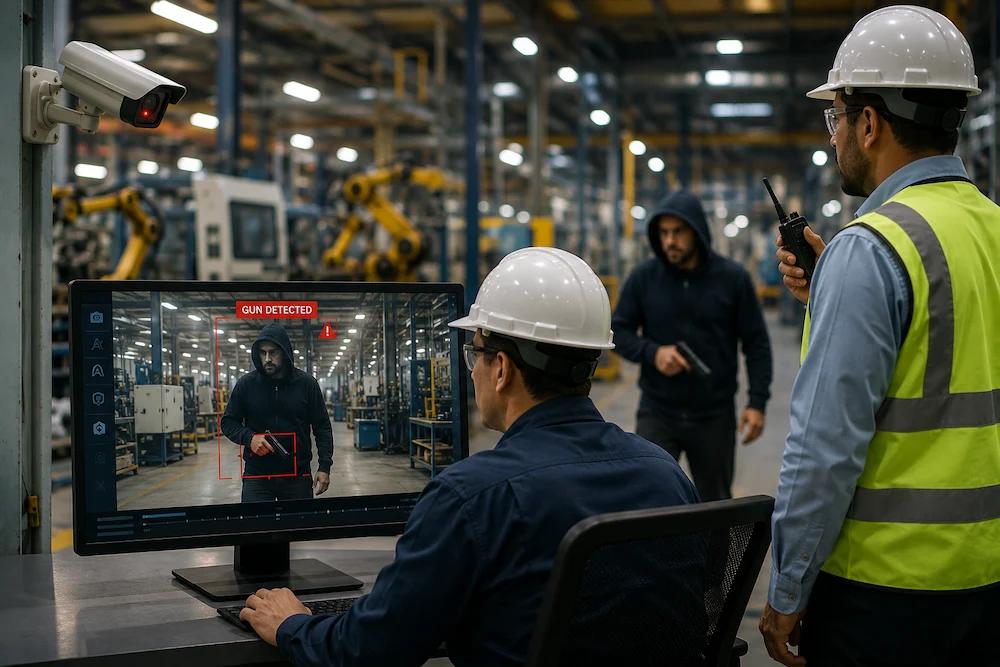
Manufacturing facilities face safety challenges such as workplace violence, unauthorized weapon access, delayed threat detection, and limited visibility across large industrial sites. Manufacturing safety issues and solutions AI gun software uses computer vision and artificial intelligence to monitor existing security cameras, detect firearms in real time, alert security teams within seconds, and trigger automated emergency response protocols. This helps manufacturers strengthen workplace safety, reduce response times, protect employees, and enhance overall facility security while leveraging existing surveillance infrastructure.
Manufacturing facilities face unprecedented security challenges in 2024. From workplace violence incidents to unauthorized weapon access, modern factories must address threats that traditional security measures cannot adequately handle. Manufacturing safety issues and solutions ai gun software represents a transformative approach to facility protection, combining computer vision, machine learning, and automated response protocols to detect weapons before incidents occur.
The stakes are significant. According to the Bureau of Labor Statistics, manufacturing ranks among the top industries for workplace violence incidents, with facilities averaging 500 or more employees facing the highest risk profiles. Traditional security approaches, including manual bag checks and periodic patrols, leave critical gaps that bad actors can exploit.
What Is AI Gun Software for Manufacturing?
AI gun software uses computer vision and deep learning algorithms to automatically detect firearms and other weapons through existing security camera infrastructure. When integrated into manufacturing environments, these systems provide continuous monitoring across entry points, production floors, parking areas, and perimeter zones. Detection triggers immediate alerts to security personnel, enabling response times measured in seconds rather than minutes.
Quick Takeaways
- AI gun detection systems achieve 95 to 99 percent accuracy rates in controlled manufacturing environments
- Integration with existing camera infrastructure reduces implementation costs by 40 to 60 percent compared to hardware replacement
- Average detection-to-alert time drops from minutes to under 3 seconds
- Systems operate 24/7 without fatigue-related performance degradation
- False positive rates in mature deployments fall below 1 percent
- ROI timelines typically range from 12 to 24 months based on insurance premium reductions and incident prevention
Comparison Table: Traditional Security vs AI Gun Detection Systems
| Factor | Traditional Security | AI Gun Detection |
|---|---|---|
| Detection Speed | Minutes to never | Under 3 seconds |
| Coverage Area | Limited patrol zones | All camera feeds simultaneously |
| Operating Hours | Shift dependent | 24/7 continuous |
| Human Error Factor | High fatigue impact | Consistent performance |
| Scalability | Linear cost increase | Marginal cost per camera |
| Integration | Standalone systems | Unified security platform |
| Documentation | Manual incident reports | Automated logging and evidence |
| Cost Structure | Ongoing personnel costs | Initial deployment plus maintenance |
Understanding Manufacturing Safety Issues and Solutions AI Gun Software Architecture
AI gun detection systems for manufacturing environments operate through a multi-layer architecture designed for industrial conditions. The foundation begins with edge computing devices that process video feeds locally, reducing bandwidth requirements and latency.
The core detection engine employs convolutional neural networks trained on millions of weapon images across varying lighting conditions, angles, and occlusion scenarios. Manufacturing facilities present unique challenges, including variable lighting from welding operations, heavy machinery shadows, and workers carrying tool cases that may visually resemble weapon cases.
Successful implementations address these challenges through custom model training. Facilities provide sample footage from their specific environments, allowing algorithms to learn the visual baseline of normal operations. This contextual awareness dramatically reduces false positives from items like nail guns, power drills, and other industrial equipment.
For organizations evaluating manufacturing AI solutions, gun detection represents one component within broader safety and operations platforms. Integration with access control systems, visitor management, and emergency response protocols creates comprehensive security ecosystems.
How AI Threat Detection Manufacturing Systems Identify Weapons
AI threat detection manufacturing platforms employ multiple identification methods working in concert. Primary visual detection relies on object recognition algorithms trained to identify firearm silhouettes, barrel shapes, and characteristic weapon geometries.
Secondary analysis examines behavioral patterns. Concealment behaviors, unusual access patterns, and movement anomalies trigger additional scrutiny from the system. A person repeatedly approaching entry points without entering, or moving through facilities in patterns inconsistent with work duties, generates alerts for human review.
Tertiary systems analyze contextual factors. Time of day, shift schedules, and expected personnel counts provide baselines against which current conditions are measured. An individual in production areas during off hours, or in restricted zones without authorization, elevates threat scores even before weapon detection occurs.
The most sophisticated gun detection systems factories deploy today incorporate pose estimation. By analyzing body positioning and hand movements, systems can identify concealed carry indicators and reaching behaviors that precede weapon display.
Real-Time Security Monitoring Implementation Strategies
Real-time security monitoring through AI gun software requires careful implementation planning. Successful deployments follow structured phases that minimize disruption to manufacturing operations while maximizing detection coverage.
Phase one involves camera infrastructure assessment. Existing camera positions are evaluated for coverage gaps, image quality, and network connectivity. Most facilities require some camera repositioning or additions to eliminate blind spots at entry points and high-traffic areas.
Phase two addresses network architecture. AI gun detection generates significant data traffic during analysis. Facilities must ensure sufficient bandwidth from camera locations to processing servers, with redundancy built in for critical zones.
Phase three encompasses integration with existing security systems. Alert routing must connect with security operations centers, facility managers, and, where appropriate, local law enforcement. Response protocols define escalation paths based on threat confidence levels and detection locations.
Organizations implementing quality control inspection systems often leverage the same infrastructure investments for security applications. Camera networks serving production quality monitoring can simultaneously feed gun detection algorithms, maximizing return on infrastructure spending.
Workplace Violence Prevention AI: Beyond Detection
Workplace violence prevention AI extends beyond weapon identification to address the full spectrum of facility security concerns. Comprehensive platforms incorporate access control integration, allowing immediate lockdown of specific zones when threats are detected.
Evacuation management features guide personnel through optimal exit routes based on threat locations. Digital signage systems display real-time instructions, while mobile notifications alert employees who may be in isolated areas without visual contact with signage.
Evaluate AI Security Solutions for Your Manufacturing Facility
Schedule Security AssessmentPost-incident analysis capabilities prove equally valuable. Systems automatically compile video evidence, generate timeline reconstructions, and produce reports suitable for law enforcement and insurance documentation. This automated evidence preservation eliminates the risk of critical footage being overwritten or improperly handled.
Training integration allows security teams to review near-miss incidents and refine response protocols. Simulated scenarios test response times and identify procedural gaps before real incidents occur.
Manufacturing Facility Security: Industry-Specific Considerations
Manufacturing facility security presents unique requirements that generic security solutions often fail to address. Production environments involve constant movement of materials, personnel, and vehicles that create complex visual scenes for AI analysis.
Heavy equipment operation generates dust, steam, and airborne particulates that degrade camera image quality. Hardened camera housings with cleaning systems ensure consistent image capture across industrial conditions.
Shift change periods create surge conditions with hundreds of personnel moving through entry points simultaneously. Systems must maintain detection accuracy during these peak periods without generating bottlenecks that impact production schedules.
Union considerations also factor into implementation decisions. Clear communication with labor representatives about system capabilities and limitations builds workforce acceptance. Emphasizing that systems protect all personnel, rather than serving surveillance purposes, addresses common concerns.
Facilities investing in predictive maintenance AI platforms often find natural synergies with security implementations. Both systems rely on continuous monitoring infrastructure and anomaly detection algorithms, creating shared technology foundations.
AI-Powered Safety Solutions: Integration With Emergency Response
AI-powered safety solutions achieve maximum effectiveness through deep integration with emergency response systems. When threats are detected, automated actions can include activating strobe lights and audible alarms in affected zones while maintaining normal conditions elsewhere to prevent panic.
Direct integration with 911 dispatch systems transmits verified threat information to first responders before they arrive on scene. Video feeds can be shared with responding officers, providing real-time situational awareness that improves tactical decision-making.
Mass notification systems push alerts through multiple channels simultaneously. Text messages, email notifications, desktop alerts, and PA announcements ensure personnel receive warnings regardless of their current communication access.
Building automation integration enables physical security responses. Doors can be locked or unlocked based on threat locations, elevators can be directed to safe floors, and HVAC systems can be configured to limit air movement in affected areas for active shooter scenarios.
Automated Threat Response: Speed and Accuracy Benchmarks
Automated threat response capabilities define the value proposition of AI gun detection systems. Human security operators, regardless of training and vigilance, cannot simultaneously monitor dozens of camera feeds with consistent attention.
Industry benchmarks for AI detection systems show average time from weapon appearance to alert generation of 1.5 to 3 seconds. Human operators monitoring the same feeds average 30 to 120 seconds for detection, with many instances going undetected entirely during testing scenarios.
Accuracy metrics require careful interpretation. Raw accuracy percentages measuring correct identifications divided by total images analyzed typically exceed 99 percent. However, the critical metric is detection rate for actual threat scenarios combined with false positive frequency.
Best-in-class systems achieve detection rates above 95 percent for visible weapons while maintaining false positive rates below 0.5 percent per camera per day. These metrics translate to security teams receiving 1 to 3 false alerts daily across typical facility camera counts, a manageable investigation workload.
For manufacturers exploring broader AI consulting and strategy services, gun detection implementations provide valuable learning experiences for enterprise AI adoption.
Use Cases: Where AI Gun Software Delivers Maximum Impact
Entry point monitoring represents the highest value application for AI gun detection. Manufacturing facilities typically have limited controlled entry points where all personnel and visitors must pass. Concentrating detection capabilities at these chokepoints maximizes coverage efficiency.
Parking lot surveillance addresses pre-entry threats. Detection of weapons in parking areas provides additional response time for facility lockdown before individuals reach building entry points.
Loading dock security protects vulnerable access points that often receive less security attention than main entrances. Delivery personnel, contractors, and third-party logistics workers create constant traffic that can mask unauthorized access.
Perimeter monitoring identifies threats before they reach facility boundaries. Individuals approaching facilities with visible weapons can be detected early enough to implement full lockdown procedures and evacuate personnel from buildings.
Executive protection scenarios warrant dedicated coverage for administration areas, conference rooms, and executive offices where high-value targets may be located.
Industry Applications: Manufacturing Sector Deployment Patterns
Automotive manufacturing facilities represent early adopters of AI gun detection technology. Large workforces, multiple shifts, and extensive facility footprints create security challenges that justify technology investment.
Food and beverage manufacturing prioritizes these systems due to public health implications of security incidents. Contamination risks and supply chain responsibilities create heightened security requirements.
Pharmaceutical manufacturing combines workplace violence prevention with controlled substance security. The same detection systems that identify weapons can be configured to detect unauthorized removal of valuable materials.
Aerospace and defense manufacturing operates under regulatory frameworks that mandate specific security capabilities. AI detection systems help satisfy compliance requirements while improving actual security outcomes.
Chemical manufacturing facilities must protect against both workplace violence and terrorism scenarios. Critical infrastructure designations bring heightened security obligations that AI systems help address efficiently.
Organizations seeking to improve operational efficiency find that security investments often deliver secondary benefits through better facility monitoring and access management.
Build a Comprehensive Manufacturing Security Strategy
Discuss Your Security RequirementsBuyer Journey Insights: Evaluating AI Gun Detection Solutions
Organizations evaluating AI gun software solutions typically progress through defined stages. Initial awareness often follows industry incidents or regulatory changes that highlight security gaps.
Research phases involve understanding technology capabilities and limitations. Decision-makers must distinguish between marketing claims and verified performance metrics. Requesting references from similar manufacturing environments provides reality checks on vendor claims.
Pilot programs allow evaluation of system performance in actual operating conditions. Three- to six-month pilots covering representative facility sections generate sufficient data for informed expansion decisions.
Total cost of ownership analysis must include hardware, software licensing, integration services, training, and ongoing maintenance. Cloud-based processing options may reduce upfront costs but create ongoing subscription obligations.
Vendor stability assessments ensure chosen providers will remain operational throughout expected system lifespans. AI security represents an emerging market where vendor consolidation and failures remain common.
For comprehensive security implementations, organizations often work with specialized AI agents development partners who can customize solutions for specific facility requirements.
Implementation Best Practices: Lessons From Successful Deployments
Successful AI gun detection implementations share common characteristics. Executive sponsorship ensures adequate budgets and organizational priority for security initiatives.
Cross-functional implementation teams include security, IT, operations, human resources, and legal representatives. Each function contributes essential perspectives on system design and policy development.
Phased rollouts starting with highest risk areas allow learning before full-scale deployment. Entry points and executive areas typically receive priority coverage.
Continuous training programs keep security personnel proficient with evolving system capabilities. Technology updates require corresponding procedure updates and refresher training.
Regular testing validates system performance. Simulated scenarios using training weapons verify detection accuracy and response protocol effectiveness.
Documentation of all policies and procedures creates audit trails for regulatory compliance and liability protection. Clear records of security investments and operational diligence prove valuable in post-incident legal proceedings.
Conclusion
Manufacturing safety issues and solutions, AI gun software represents a critical evolution in facility protection strategies. As workplace violence incidents continue affecting industrial environments, reactive security approaches prove insufficient for protecting personnel and operations.
AI-powered detection systems provide the continuous vigilance that human security teams cannot sustain. Sub-three-second detection times, consistent 24/7 monitoring, and integration with automated response systems create security capabilities that dramatically improve facility safety postures.
Implementation requires careful planning, appropriate investment, and ongoing commitment to system maintenance and procedure refinement. Organizations that approach these deployments strategically achieve meaningful security improvements while generating returns through insurance savings, incident prevention, and enhanced workforce confidence.
The technology continues advancing. Future capabilities will include improved accuracy, broader threat type detection, and deeper integration with building systems. Manufacturers investing in current-generation systems establish foundations for evolving security ecosystems that will protect facilities for years to come.