Key Takeaway
FoodTech automation and precision agriculture AI transform supply chain management by connecting farm-level yield data, cold chain sensors, and AI demand forecasting into a single intelligent workflow—reducing food waste by 20–40%, cutting crop-to-consumer lead times, and enabling recall traceability in hours instead of days. Enterprises that deploy AI across agri-food supply chains report 30–50% fewer supply disruptions and 10–20% lower total operating costs.
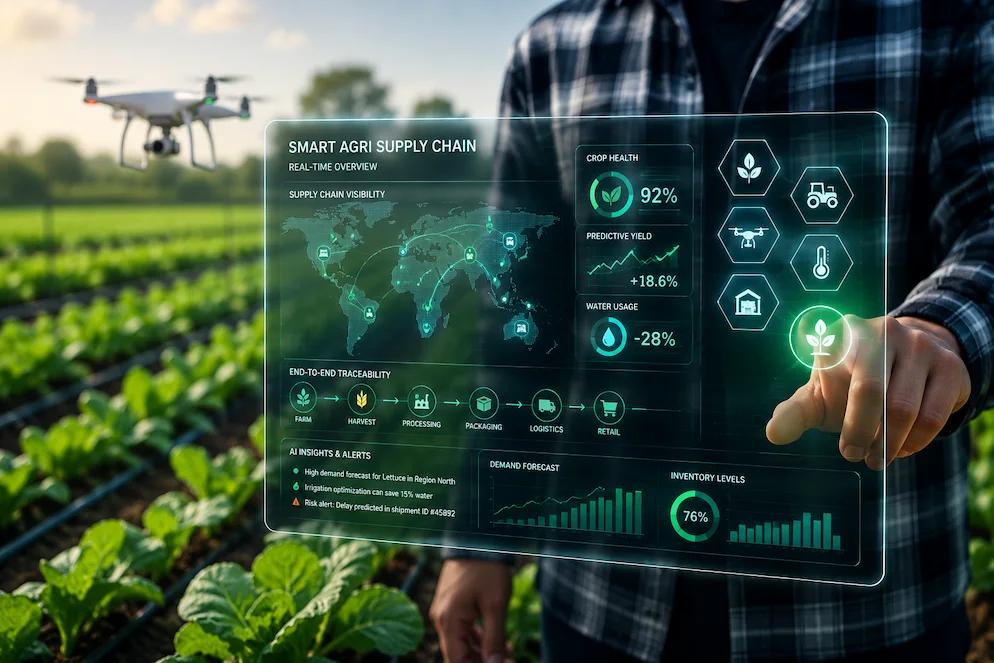
FoodTech automation and precision agriculture AI are transforming supply chain management by replacing reactive, fragmented food logistics with end-to-end intelligent visibility - from soil sensors and autonomous harvesting equipment on the farm to AI-powered demand forecasting, cold chain monitoring, and traceability platforms at every downstream node. The combined effect of foodtech automation, precision ag, and AI supply chain innovation is a supply chain that predicts disruption instead of reacting to it, reduces food waste by 20–40%, compresses crop-to-consumer lead times, and delivers real-time provenance data at every handoff - capabilities that manual operations and legacy software cannot replicate at enterprise scale.
Every year, roughly one-third of all food produced globally is lost or wasted - approximately 1.3 billion tonnes, according to the FAO. The majority of that loss happens not on the farm or at the dinner table, but in the supply chain: in transit, in cold storage, at distribution hubs, and in demand-forecasting errors that produce surpluses no one can move before spoilage sets in.
Meanwhile, precision agriculture is generating more data per acre than any previous agricultural technology - from soil moisture sensors and satellite imagery to autonomous tractor telemetry and drone-based crop health mapping. The gap between data-rich farms and data-blind supply chains has never been wider.
FoodTech automation and precision agriculture AI are converging to close it. The result is an ai in food supply chain where yield predictions drive procurement before seeds are even planted, where cold chain AI detects spoilage risk before a load is compromised, and where every unit of produce carries a digital provenance trail from field to fork.
This article covers how that transformation works, which technologies are driving it, and what enterprises need to deploy it at a production scale.
The agri-food supply chain is one of the most complex in any industry. It involves:
- Biological variability (weather, pest pressure, soil conditions) makes the supply inherently unpredictable
- Perishability constraints that compress decision windows to hours, not days
- Multi-tier traceability requirements that span dozens of handoffs across growers, processors, distributors, and retailers
- Regulatory frameworks (FDA FSMA, EU Farm to Fork, USDA compliance) that demand documentation at every node
- Demand signals that shift faster than traditional procurement cycles can respond to
Traditional supply chain management was designed for manufactured goods with stable specifications and multi-week replenishment cycles. It was never designed for fresh produce, dairy, or protein supply chains where a single-day weather event can eliminate 20% of regional supply and where consumers increasingly demand real-time traceability from farm to shelf.
Foodtech automation, precision ag AI supply chain innovation attacks this problem at every layer simultaneously - integrating field-level intelligence with logistics intelligence, demand intelligence, and compliance automation in a way that no prior technology could.
What Is FoodTech Automation?
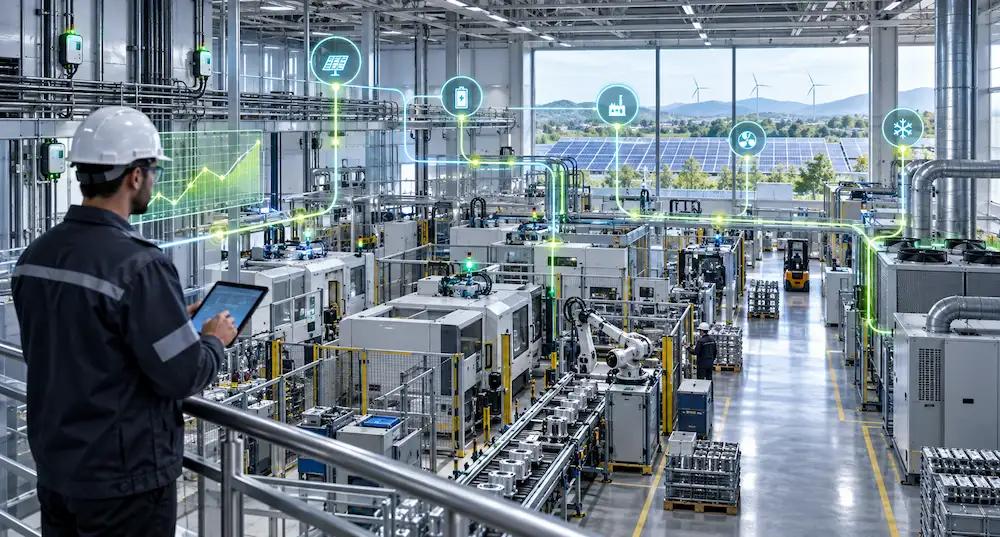
FoodTech automation refers to the application of AI, robotics, computer vision, IoT, and intelligent software to automate and optimize processes across the food value chain - from production and processing through packaging, logistics, and retail.
Key capabilities include:
- AI-powered quality inspection on processing lines that replaces manual grading and sorting
- Automated cold chain monitoring that predicts and prevents temperature excursions before the product is compromised
- Intelligent demand planning that ingests consumer trends, weather forecasts, and promotional calendars simultaneously
- Robotic picking and packing that scales throughput without scaling headcount
- Supply chain visibility platforms that provide real-time tracking across every distribution node
FoodTech automation does not replace the food supply chain - it instruments it. Every node becomes a data source; every data source feeds AI systems that optimize the next decision in the chain.
What Is Precision Agriculture AI?
Precision agriculture AI is the application of machine learning, computer vision, IoT sensor networks, and autonomous systems to farm operations - enabling growers to make field-level decisions based on data rather than intuition or historical averages.
Core precision agriculture technologies include:
- Satellite and drone imagery processed by AI vision models to detect crop stress, disease, and yield variability across fields
- IoT soil sensors that provide real-time readings of moisture, pH, nutrient levels, and temperature at multiple depths
- Weather-integrated AI forecasting that predicts yield outcomes weeks in advance and adjusts inputs accordingly
- Autonomous agricultural equipment - planting, spraying, and harvesting machines guided by GPS and real-time crop data
- AI crop disease detection that identifies pathogen signatures before they spread across a field
The supply chain implications of precision agriculture are profound: for the first time, buyers and processors can receive yield forecasts with genuine accuracy 8–12 weeks before harvest, transforming procurement from a reactive scramble into a planned, data-driven process.
The Gap FoodTech and Precision Ag Are Closing
For decades, farming and supply chain management operated on opposite sides of an information wall. Farmers knew their fields; supply chain managers guessed at supply. The result was systemic inefficiency: over-procurement that led to waste, under-procurement that led to stockouts and price volatility, and compliance failures driven by the inability to trace a contaminated product back to its origin.
Foodtech automation and precision agriculture AI are dismantling that wall. When farm-level data flows directly into supply chain planning systems:
- Demand forecasts are calibrated against actual yield data, not historical averages
- Cold chain routing is optimized based on produce maturity and transit time, not standard protocols
- Quality inspection begins in the field - flagging below-standard product before it enters the distribution network
- Recall and traceability events that once took days are resolved in hours with digital provenance records
The convergence of these two technology streams is what makes the current transformation of agri-food supply chains qualitatively different from previous waves of supply chain software. Enterprises already investing in operational efficiency in manufacturing with AI are now extending the same AI architectures into their agri-food supply operations, with a significant compounding impact.
7 Ways FoodTech Automation Is Transforming Supply Chains
1. AI-Powered Crop Yield Forecasting and Demand Planning
Traditional demand planning for fresh produce relied on seasonal averages, historical purchase patterns, and buyer intuition - a process that consistently underestimated supply volatility. Precision agriculture AI changes the input data fundamentally.
AI yield forecasting models integrate satellite multispectral imagery, soil sensor data, weather predictions, and historical yield records to generate field-level harvest projections with 85–95% accuracy at 8–12 weeks out. These projections feed directly into supply chain demand planning systems, enabling buyers to lock procurement contracts against real yield data - reducing both over-procurement waste and emergency spot-market purchasing.
Enterprises deploying AI demand forecasting for supply chain planning across their agri-food operations report 30–50% reduction in forecast error and 20–35% reduction in emergency procurement events.
2. Precision Irrigation and Resource Optimization
Water is the most constrained resource in global agriculture, and its management directly affects both yield quality and supply chain consistency. Precision agriculture AI uses soil moisture sensors, evapotranspiration models, and weather-integrated forecasts to deliver exactly the right amount of water to each field zone - eliminating both over-watering waste and drought-stress yield loss.
The supply chain impact is supply predictability: precision-irrigated crops produce more consistent yields with tighter quality specifications, which reduces the variability that supply chain planners have historically had to buffer with excess safety stock.
3. Autonomous Harvesting and Post-Harvest Automation
Harvesting labor is the single most variable cost and capacity constraint in fresh produce supply chains. Labor shortages, weather delays, and manual harvesting inconsistencies create supply timing volatility that cascades through the entire downstream chain.
Autonomous harvesting systems - robotic pickers guided by computer vision and AI-optimized harvest scheduling - bring predictability to the supply side. Robotic systems harvest at a consistent speed regardless of labor availability, operate on AI-optimized schedules aligned to ripeness data, and generate per-unit quality and provenance data that manual harvesting cannot match.
Post-harvest automation - AI-powered sorting, grading, and packing lines - extends this predictability through the first processing nodes, producing output specifications that downstream buyers can plan against with genuine confidence.
4. AI-Driven Cold Chain and Logistics Management
Cold chain failure is responsible for an estimated 9% of global food loss - a product that was perfectly good at origin but spoiled before delivery. Traditional cold chain management relied on scheduled temperature checks and standardized protocol adherence. It could not predict or prevent excursion events before they caused irreversible product loss.
Struggling with supply visibility across your agri-food network?
Get a Free Supply Chain AI AssessmentAI cold chain management instruments every point in the cold chain - refrigerated trucks, distribution center docks, retail cold rooms - with IoT sensors feeding real-time temperature, humidity, and door-open data into AI models that predict excursion risk before it materializes. When risk is detected, the system automatically reroutes shipments, adjusts prioritization for at-risk loads, and alerts logistics managers with specific, actionable recommendations.
Combined with AI-optimized route planning - which accounts for traffic, delivery windows, vehicle capacity, and product shelf life simultaneously - AI cold chain management typically reduces cold chain loss by 25–40% in the first year of deployment.
5. Food Traceability and Safety Compliance Automation
Food safety recalls cost the U.S. food industry an estimated $10 billion annually - and the majority of that cost accumulates not from the contamination event itself, but from the inability to trace affected product quickly and precisely. When a recall takes days to trace, the precautionary scope must cover entire product categories rather than specific batches, multiplying both cost and brand damage.
FoodTech automation creates a digital provenance trail at every production and logistics handoff - linking field location, harvest date, processing batch, cold chain history, and distribution routing to every unit of product in the supply chain. When a safety event occurs, AI traceability systems identify the affected population of product in hours rather than days, with precision that allows surgical recalls rather than categorical ones.
This capability is not optional for enterprises operating under FDA FSMA, EU Farm to Fork Regulation, or USDA food safety requirements - and AI automation is increasingly the only way to achieve it at scale across complex, multi-tier supply chains.
6. Smart Packaging and Waste Reduction
Packaging is both a cost center and a sustainability indicator in agri-food supply chains. Over-packaging adds cost and materials waste; under-packaging drives product damage and food loss. Manual packaging specification decisions - based on product type and historical damage rates - leave significant optimization potential untapped.
AI-powered packaging optimization analyzes product-specific fragility, transit conditions, shelf life requirements, and retailer specifications to recommend precise packaging configurations at the unit level. Combined with smart packaging materials (time-temperature indicators, modified atmosphere packaging sensors), AI packaging systems provide continuous quality status information throughout the distribution chain.
For food manufacturers specifically, the detailed analysis of AI to optimize packaging for food manufacturers covers how AI vision systems, material optimization models, and packaging line automation work together to reduce waste and improve line performance.
7. AI-Enabled Supply Chain Visibility and Risk Management
The 2020–2023 supply chain disruption period exposed the structural fragility of food supply chains built on single-source dependencies, just-in-time inventory, and reactive risk management. AI supply chain visibility platforms - which continuously monitor supplier health, geopolitical risk signals, logistics disruptions, and weather events - give agri-food enterprises early warning of supply risks weeks before they manifest as delivery failures.
Specific capabilities include:
- Multi-tier supplier risk scoring that monitors financial health, capacity utilization, and geopolitical exposure across Tier 1 and Tier 2 suppliers simultaneously
- AI-powered inventory repositioning that dynamically adjusts safety stock across distribution nodes based on current demand volatility and lead time variability
- Disruption simulation that models the downstream impact of a supplier failure or logistics disruption across the full supply network before it occurs
Enterprises that have deployed AI in manufacturing process automation alongside supply chain visibility platforms report 30–50% reduction in supply disruption events and 10–20% reduction in total supply chain operating costs.
Key Technologies Powering FoodTech and Precision Ag Supply Chain Innovation
The transformation of agri-food supply chains is powered by a convergence of technologies that are individually mature but collectively represent a step-change in what supply chain intelligence can do.
Computer Vision applied to crop health monitoring, harvest grading, and food safety inspection - replacing manual visual assessment with AI models that detect defects, disease, and quality deviations at machine speed and scale. The same underlying technology that powers AI defect detection in food production on processing lines is being extended upstream to field-level quality assessment via drone and satellite imagery.
IoT Sensor Networks that instrument every physical node in the supply chain - soil sensors, weather stations, equipment telemetry, cold chain monitors, and warehouse environmental sensors - generating the real-time data streams that AI models require to operate at full accuracy.
Predictive Analytics and Machine Learning that transform raw sensor data into actionable operational intelligence - yield forecasts, spoilage risk scores, demand predictions, and supplier risk ratings - at a speed and scale that no human analyst team could replicate.
Robotics and Autonomous Systems that bring precision and predictability to physically variable agricultural tasks - planting, pruning, harvesting, sorting, and packing - reducing both labor dependency and output variability.
Blockchain-Integrated Traceability that creates immutable provenance records at every supply chain handoff, enabling rapid, precise recalls and delivering consumer-facing transparency that premium food brands increasingly require.
Digital Twins of supply chain networks - live simulation models that mirror actual physical operations - that allow supply chain managers to test scenarios (a supplier failure, a weather event, a demand spike) before they occur and develop optimized response plans in advance.
Not sure which AI technology fits your supply chain first?
Talk to an Intellectyx Supply Chain AI ExpertWhy You Need a Supply Chain Software Development Company
Off-the-shelf supply chain software was designed for the median use case - stable products, predictable lead times, single-tier supplier relationships. The agri-food supply chain is not the median use case. It is one of the most complex, variable, and regulation-intensive supply chains in any industry.
Generic enterprise supply chain platforms - ERPs with supply chain modules, commodity TMS solutions - cannot handle:
- Crop yield variability as an input to demand planning
- Perishability and shelf life as live constraints in logistics optimization
- Field-to-fork provenance requirements at the unit level
- Cold chain risk prediction that integrates sensor data with spoilage models
- Multi-country regulatory compliance documentation is generated automatically at each handoff
Organizations that attempt to deploy standard supply chain software in agri-food environments consistently find that they are customizing it so heavily that the platform's standard features provide minimal value, while the customization debt accumulates into a technical architecture that is brittle, expensive to maintain, and unable to incorporate new AI capabilities.
Working with a Supply Chain Software Development Company that builds custom AI-native supply chain systems - rather than configuring standard platforms - is the approach that delivers production-grade performance in complex agri-food environments. Custom systems are designed around your specific crop varieties, supplier network topology, regulatory requirements, and logistics constraints - not around a vendor's product roadmap.
Enterprises evaluating this decision should consider custom AI agents development as the architecture layer that allows supply chain intelligence to operate autonomously across every workflow - from demand sensing and procurement through logistics optimization and compliance documentation.
Running manual traceability processes that slow down your recall response?
See How AI Automates End-to-End TraceabilityHow Intellectyx Supports AgriFood and FoodTech Enterprises
Intellectyx builds production-grade AI and agentic systems for enterprises in manufacturing, agri-food, and technology operations. For FoodTech and precision agriculture supply chain deployments, our work spans:
AI supply chain visibility platforms - custom-built systems that integrate field data, supplier signals, logistics telemetry, and demand intelligence into a unified operational intelligence layer for agri-food supply chain teams.
Precision agriculture AI integration - connecting farm-level IoT, drone imagery, and weather data into supply chain planning systems, so that yield forecasts drive procurement decisions weeks before harvest.
Cold chain automation - AI monitoring and alerting systems that predict and prevent cold chain excursions in real time, with automated rerouting and escalation workflows.
Food traceability and compliance automation - end-to-end digital provenance systems that generate regulatory documentation automatically at each supply chain handoff, enabling rapid, precise recalls and consumer-facing transparency.
Agentic supply chain automation - autonomous AI agents that manage procurement workflows, supplier performance monitoring, and logistics coordination without requiring human intervention at every step.
Our manufacturing AI agents development practice brings the same production-grade deployment rigor to agri-food supply chain AI that we've applied across manufacturing operations - with domain expertise in the specific data types, regulatory constraints, and operational complexity of food and agriculture supply chains.
If your organization is evaluating how AI coworkers and autonomous systems can extend the capacity of your supply chain team without proportional headcount growth, the Intellectyx guide to AI coworkers transforming manufacturing operations provides directly applicable architecture patterns for agri-food environments.
Ready to Build an AI-Powered Agri-Food Supply Chain?
Intellectyx moves from use case scoping to production deployment in 8–16 weeks.
Schedule a Free Consultation