
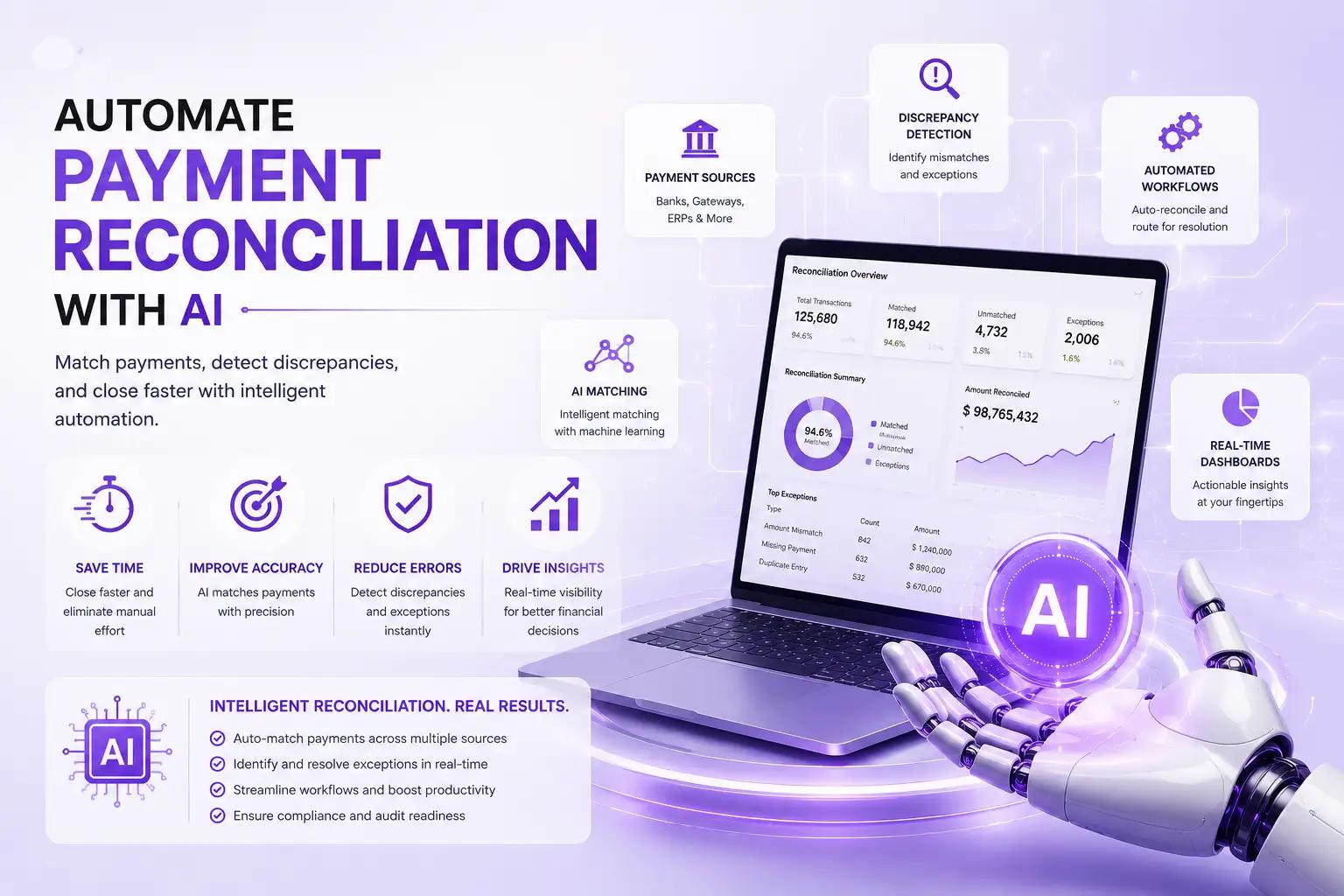
Payment reconciliation remains one of the most time-consuming tasks for finance teams. Manual matching of transactions across bank statements, invoices, and internal records creates bottlenecks that delay month-end close and introduce costly errors. When you automate payment reconciliation with AI, you transform a tedious manual process into an intelligent workflow that learns, adapts, and improves over time.
This guide walks finance leaders through the complete implementation process, from assessing current workflows to measuring ROI after deployment.
What Does It Mean to Automate Payment Reconciliation with AI?
AI-powered payment reconciliation uses machine learning algorithms to automatically match transactions across multiple data sources, identify discrepancies, and flag exceptions for human review. Unlike rule-based automation, AI reconciliation learns from historical patterns and accountant decisions to continuously improve matching accuracy. Finance teams typically achieve 85-95% straight-through processing rates, reducing manual intervention to only complex exceptions.
Quick Takeaways
- AI reconciliation reduces manual matching effort by 70-90% compared to spreadsheet-based processes
- Machine learning models improve matching accuracy over time by learning from accountant corrections
- Implementation typically requires 8-16 weeks for mid-market organizations
- Integration with existing ERP and banking systems is essential for success
- Exception handling workflows determine overall efficiency gains
- ROI typically materializes within 6-12 months through labor savings and error reduction
Comparison: Manual vs. Rule-Based vs. AI Payment Reconciliation
| Capability | Manual Process | Rule-Based Automation | AI-Powered Reconciliation |
|---|---|---|---|
| Matching Accuracy | 85-92% | 90-95% | 95-99% |
| Processing Time | Hours to days | Minutes to hours | Seconds to minutes |
| Exception Handling | Fully manual | Partially automated | Intelligent prioritization |
| Learning Capability | None | None | Continuous improvement |
| Complex Pattern Recognition | Limited | Fixed rules only | Advanced pattern matching |
| Scalability | Linear cost increase | Moderate scalability | High scalability |
| Initial Setup Cost | Low | Medium | Medium to high |
| Long-term Cost Efficiency | Poor | Moderate | Excellent |
Why Traditional Payment Reconciliation Falls Short
Traditional payment reconciliation struggles because transaction data arrives in inconsistent formats across multiple systems. Finance teams managing reconciliation for organizations with hundreds or thousands of daily transactions face several persistent challenges.
Bank statements use different naming conventions than accounts receivable systems. Customers pay multiple invoices in a single transaction without clear references. Currency conversions, timing differences, and partial payments create matching complexity that simple rules cannot address.
According to Deloitte research, finance teams spend approximately 30% of their time on data gathering and reconciliation activities. This manual effort creates opportunity costs, as skilled accountants focus on matching transactions rather than strategic analysis.
The error rates compound these inefficiencies. Manual reconciliation introduces human errors that cascade through financial statements. Undetected discrepancies lead to cash flow miscalculations, inaccurate forecasting, and compliance risks during audits.
Organizations exploring AI integration in custom business software often start with reconciliation because the ROI is measurable and the process is well-defined.
How to Automate Payment Reconciliation with AI: The Complete Process
Implementing AI reconciliation requires systematic planning across technology, process, and change management dimensions. This section provides the step-by-step framework finance teams need for successful deployment.
Step 1: Assess Your Current Reconciliation Workflow
Document every touchpoint in your existing reconciliation process before selecting technology. Map data sources including bank feeds, ERP transactions, payment processor reports, and accounts receivable records. Identify where manual intervention currently occurs and quantify the time spent on each activity.
Calculate your current metrics: transactions processed per analyst, average time to close reconciliation, exception rates, and error frequencies. These baselines become critical for measuring AI implementation success.
Review historical exceptions to understand the complexity of your matching challenges. Patterns in past exceptions inform the training data requirements for machine learning models.
Step 2: Define Integration Requirements
AI reconciliation effectiveness depends entirely on data access. Identify every system that holds transaction data relevant to reconciliation:
- Core banking and treasury management systems
- ERP platforms and general ledger
- Accounts receivable and accounts payable modules
- Payment processors and merchant services
- E-commerce platforms
- Point-of-sale systems
Determine the available integration methods for each system. Modern AI reconciliation platforms typically support API connections, SFTP file transfers, direct database queries, and manual file uploads. Real-time API integrations deliver the fastest reconciliation cycles.
Finance teams working with custom AI agents development can build specialized connectors for proprietary systems not covered by standard integrations.
Step 3: Prepare and Cleanse Historical Data
Machine learning models require quality training data to deliver accurate matching. Export historical reconciliation data spanning at least 12 months to capture seasonal patterns and edge cases.
Cleanse the data by standardizing formats, removing duplicates, and correcting obvious errors. Flag previously resolved exceptions with their resolution methods, as these examples train the AI to handle similar situations automatically.
Data preparation typically consumes 30-40% of implementation timeline. Organizations that shortcut this phase experience lower matching accuracy and longer time-to-value.
Step 4: Configure Matching Rules and AI Models
AI reconciliation combines deterministic rules with machine learning models. Configure exact-match rules for straightforward scenarios: transaction amounts, dates, and reference numbers that align perfectly across systems.
Train probabilistic models for fuzzy matching scenarios where data varies between sources. The AI learns to recognize that "ABC Corporation" and "ABC Corp" refer to the same entity, or that transactions posted one day apart likely represent the same payment.
Define confidence thresholds that determine when transactions auto-match versus requiring human review. Higher thresholds reduce false positives but increase exception volumes. Finding the right balance requires iterative tuning during pilot testing.
Step 5: Establish Exception Handling Workflows
Exceptions are inevitable even with high-accuracy AI matching. Design workflows that route exceptions to appropriate team members based on complexity, dollar amount, and resolution expertise.
Create escalation paths for exceptions that remain unresolved within defined timeframes. Establish documentation requirements so that exception resolutions become training data for model improvement.
The exception handling process often determines overall ROI. Organizations that invest in streamlined exception workflows achieve faster month-end close even when exception volumes remain constant.
Step 6: Pilot Testing and Model Refinement
Run the AI reconciliation system in parallel with existing processes for 4-8 weeks. Compare AI-generated matches against manual results to identify discrepancies and measure accuracy.
Analyze false positives where the AI incorrectly matched transactions and false negatives where it failed to identify valid matches. Both error types require model adjustments.
Collect accountant feedback on exception prioritization and suggested match confidence. This human-in-the-loop learning accelerates model improvement during the pilot phase.
Step 7: Production Deployment and Monitoring
Transition to production with clear rollback procedures in case issues emerge. Begin with less critical reconciliation processes before migrating high-stakes accounts.
Implement monitoring dashboards that track matching rates, exception volumes, processing times, and error frequencies. Set alerts for anomalies that may indicate data quality issues or model drift.
Ready to Transform Your Payment Reconciliation Process?
Schedule a ConsultationTechnology Requirements for AI Payment Reconciliation
Successful AI reconciliation implementations require specific technology capabilities that finance teams should evaluate during vendor selection.
Data Infrastructure
AI reconciliation platforms need robust data pipelines that ingest transactions from multiple sources in near real-time. Cloud-based architectures typically outperform on-premise solutions for scalability and integration flexibility.
Data lakes or warehouses store historical transactions for model training and audit purposes. Ensure the platform maintains complete transaction lineage for compliance requirements.
Machine Learning Capabilities
Evaluate the sophistication of matching algorithms. Leading platforms use ensemble methods that combine multiple model types for higher accuracy than single-algorithm approaches.
Transfer learning capabilities allow platforms to apply matching intelligence learned from other organizations while respecting data privacy. This accelerates time-to-accuracy for new implementations.
Natural language processing handles unstructured data in transaction descriptions, customer communications, and remittance advice documents.
Integration Architecture
Pre-built connectors for major ERP platforms, banking systems, and payment processors reduce implementation complexity. Evaluate connector depth, as some integrations only support basic data fields while others capture full transaction detail.
API frameworks enable custom integrations for proprietary systems. REST APIs with comprehensive documentation simplify development for internal IT teams or implementation partners.
Teams building comprehensive finance AI agents often extend reconciliation capabilities to include cash forecasting and working capital optimization.
Measuring ROI and Success Metrics
Quantifying AI reconciliation value requires tracking both efficiency gains and quality improvements across multiple dimensions.
Primary Metrics
Straight-through processing rate measures the percentage of transactions that match automatically without human intervention. Aim for 85-95% depending on transaction complexity.
Average time to reconcile tracks the elapsed time from transaction posting to reconciliation completion. AI implementations typically reduce this from days to hours.
Exception resolution time measures how quickly flagged transactions receive human review and resolution. Intelligent prioritization should reduce average resolution time by 40-60%.
Error rate captures discrepancies that reach financial statements despite reconciliation processes. AI accuracy typically reduces errors by 70-90% compared to manual processes.
Secondary Metrics
Month-end close timeline reflects overall reconciliation efficiency impact on financial reporting cycles. Organizations commonly shorten close by 2-5 days.
Staff productivity measures transactions processed per analyst, which typically increases 3-5x with AI assistance.
Audit preparation time decreases as AI maintains comprehensive matching documentation and exception records.
Organizations tracking these metrics systematically often share success stories that demonstrate measurable ROI within the first year.
See how Intellectyx delivered 3X faster break detection and resolution for a U.S. wealth and capital markets firm.
Use Cases for AI-Powered Payment Reconciliation
AI reconciliation applies across diverse finance functions and transaction types.
Bank Reconciliation
Daily bank statement reconciliation matches cleared transactions against internal records. AI handles timing differences, batch postings, and consolidations that create matching complexity.
Accounts Receivable Reconciliation
Customer payments match against outstanding invoices with AI handling partial payments, combined payments, and missing remittance information. The system learns customer-specific payment patterns over time.
Intercompany Reconciliation
Multi-entity organizations reconcile transactions between subsidiaries. AI identifies matching entries across entities with different chart of accounts structures and currencies.
Credit Card and Payment Processor Reconciliation
Merchant transactions match against payment processor settlements and bank deposits. AI manages the complexity of fees, chargebacks, and multi-day settlement timing.
Vendor Payment Reconciliation
Accounts payable reconciliation confirms that vendor payments match approved invoices and purchase orders. AI flags duplicate payments and detects potential fraud patterns.
Industry Applications
AI payment reconciliation delivers value across industries with distinct implementation considerations.
Financial Services
Banks, lending institutions, and asset managers process high transaction volumes with strict regulatory requirements. AI reconciliation supports compliance while managing operational complexity.
Loan underwriting AI agents complement reconciliation by automating related financial document processing.
Retail and E-commerce
An AI Agent for Retail Industry enables omnichannel retailers to reconcile transactions across physical stores, e-commerce platforms, and online marketplaces. It intelligently handles multiple payment methods, settlement schedules, refunds, and transaction matching, helping retailers improve financial accuracy, reduce manual reconciliation efforts, and streamline operations across all sales channels.
Manufacturing
Manufacturers reconcile supplier payments, customer receipts, and intercompany transfers across global operations. Multi-currency transactions require AI handling of exchange rate variations.
Healthcare
Healthcare organizations reconcile patient payments, insurance reimbursements, and vendor payments. AI manages the complexity of payment adjustments and denials common in healthcare billing.
Build Your AI Reconciliation Roadmap
Talk to Our Finance AI ExpertsProfessional Services
Law firms, accounting practices, and consulting firms reconcile client trust accounts and retainer payments. Strict compliance requirements demand audit trails that AI systems provide automatically.
Buyer Journey Insights: Selecting the Right Solution
Finance teams evaluating AI reconciliation solutions progress through distinct decision phases.
Awareness Phase
Teams recognize that current reconciliation processes cannot scale with business growth. Research focuses on understanding AI capabilities and vendor landscape. Content like this guide helps teams frame requirements.
Consideration Phase
Shortlisted vendors demonstrate their platforms against specific use cases. Proof-of-concept projects validate matching accuracy with actual transaction data. Teams building an AI proof of concept benefit from structured evaluation frameworks.
Decision Phase
Final selection weighs implementation requirements, total cost of ownership, and vendor stability. Reference calls with similar organizations provide implementation reality checks.
Implementation Phase
Successful implementations require executive sponsorship, dedicated project resources, and change management planning. Teams that underestimate change management complexity face adoption resistance.
Common Implementation Challenges and Solutions
Anticipating obstacles helps finance teams plan effective mitigation strategies.
Data Quality Issues
Inconsistent data formats and missing fields undermine matching accuracy. Address through data cleansing initiatives before AI deployment and ongoing data governance programs.
Integration Complexity
Legacy systems with limited API capabilities slow implementation timelines. Consider middleware solutions that bridge older systems to modern AI platforms.
Change Resistance
Accountants comfortable with existing processes may resist AI adoption. Involve team members early in the implementation to incorporate their expertise and address concerns.
Model Drift
AI accuracy degrades when business processes change but models remain static. Establish regular retraining schedules and monitoring to detect accuracy decline.
Compliance Concerns
Audit requirements demand explainability for AI-generated matches. Select platforms that provide detailed matching rationale and complete audit trails.
Organizations managing ongoing AI operations benefit from AgentOps frameworks that govern model performance and compliance.
Conclusion
The decision to automate payment reconciliation with AI represents a strategic investment that compounds value over time. Unlike static automation rules, AI reconciliation continuously improves as models learn from transaction patterns and accountant decisions.
Finance teams that follow the systematic implementation approach outlined in this guide position themselves for successful deployment. Start with thorough assessment of current workflows, invest appropriately in data preparation, and maintain focus on exception handling efficiency.
The organizations achieving the greatest returns treat AI reconciliation as a foundation for broader finance transformation. Once reconciliation operates efficiently, the same AI capabilities extend to cash forecasting, working capital optimization, and strategic financial analysis.
Learning how to automate payment reconciliation with AI is the first step toward building a finance function that scales with business growth while freeing skilled professionals for higher-value contributions.