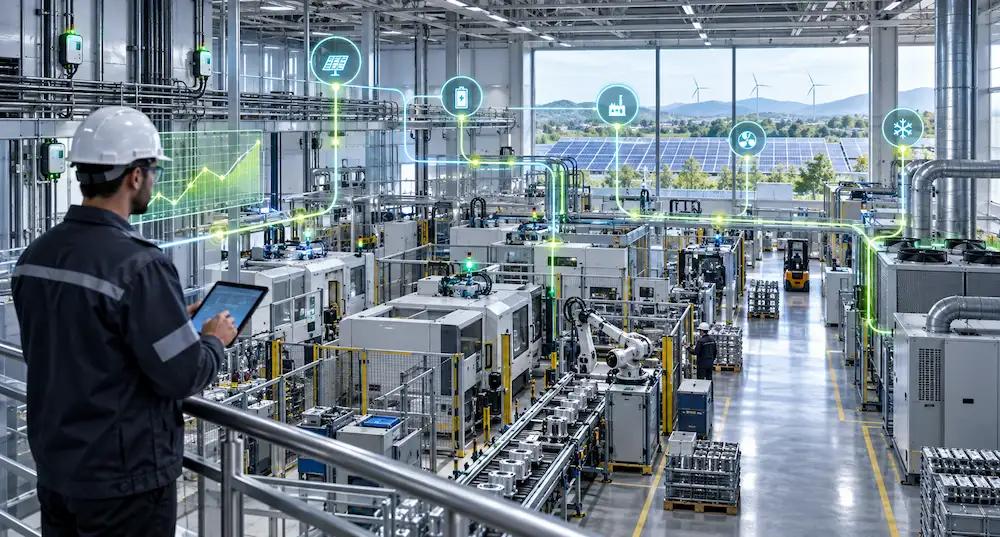

AI defect detection is the use of computer vision and deep learning to automatically identify product defects, surface anomalies, and quality issues on the production line — at speeds no human inspector can match.
A trained neural network inspects every unit in milliseconds. It never gets tired. It never misses a shift. And unlike rule-based vision systems from a decade ago, it learns from examples rather than requiring engineers to hand-code every inspection rule.
This guide covers everything manufacturing teams need to evaluate, implement, and get ROI from AI defect detection. For related context on broader AI for manufacturing strategies, see our services page. Read on for: how it works technically, accuracy benchmarks, cost by industry, a full comparison with traditional QC, step-by-step implementation, and the 10 most common questions manufacturing teams ask before deploying.
AI defect detection systems achieve 97–99.5% detection accuracy, inspect 100–1,200+ parts per minute, and typically deliver full payback within 8–18 months through scrap reduction, labour savings, and fewer customer returns. AI defect detection increasingly works alongside cobots in manufacturing collaborative robots that physically handle, move, and sort flagged defective units in real time.
What Is AI Defect Detection?
AI defect detection is an automated quality inspection approach that combines high-resolution imaging hardware with deep learning software to identify defective products on a production line without human intervention.
The system captures an image of every unit as it passes a camera station. A pre-trained convolutional neural network (CNN) analyses the image and predicts whether the unit is acceptable or defective — and if defective, which type of defect is present and where it is located. This happens in 5–50 milliseconds per unit, enabling full 100% inspection coverage at production line speeds.
This is fundamentally different from traditional machine vision systems. If you are evaluating options, our guide to AI quality control in manufacturing covers the broader quality assurance landscape — including how AI defect detection fits into an end-to-end QC strategy.
Key definition: AI defect detection = computer vision cameras + deep learning model + real-time inference engine. The model is trained on thousands of labelled images of good and defective units and deployed inline at the production line to inspect every unit automatically.
Reduce scrap, rework, and downtime through AI defect detection automation.
Get FREE ConsultationHow AI Detects Defects: Computer Vision and Deep Learning Explained
Modern AI defect detection systems follow a four-stage pipeline. Understanding each stage helps manufacturing teams evaluate vendors, set performance expectations, and plan infrastructure.
Stage 1 — Image capture
Industrial cameras (2–25 megapixel, line-scan or area-scan) photograph each unit as it moves past the inspection station. Lighting is critical — backlit, coaxial, or structured light setups are chosen based on the defect type being targeted. For sub-surface defects, X-ray, ultrasonic, or thermal imaging sensors replace visible-light cameras.
Camera placement, resolution, and frame rate are engineered to match line speed. A bottling line running at 600 bottles per minute needs cameras with faster shutter speeds and triggers than a press stamping 60 parts per minute.
Stage 2 — Preprocessing and normalisation
Raw images are cropped, resized, and normalised before inference. Preprocessing removes lighting variation, compensates for minor position shifts, and ensures the input matches the format the model was trained on. This stage runs on the edge compute device (typically an NVIDIA GPU embedded at the line) in 1–5 milliseconds.
Stage 3 — Deep learning model inference (CNN, YOLO, ResNet)
The preprocessed image is passed through a convolutional neural network. Different architectures are suited to different tasks:
- Classification networks (ResNet, EfficientNet) — is this unit acceptable or defective?
- Detection networks (YOLO, Faster R-CNN) — where in the image is the defect, and what type is it?
- Segmentation networks (Mask R-CNN, U-Net) — provide pixel-level defect maps for precise measurement and root-cause analysis.
The model outputs a confidence score per defect class. A threshold is configured (e.g. reject if confidence > 0.85) to balance detection rate against false positive rate for the specific production environment.
Stage 4 — Classification, alerting, and action
The inference result is passed to the line control system via PLC integration (OPC-UA, MQTT, or direct I/O). Defective units trigger a rejection mechanism within the reaction time window — typically 50–200 milliseconds after the camera trigger. Operators receive real-time dashboards showing defect counts, defect type distribution, and first-pass yield trends.
For teams exploring broader automation beyond inspection, our article on AI agents in manufacturing covers how autonomous AI agents handle scheduling, predictive maintenance, and supply chain decisions alongside defect detection.
Types of Defects AI Can Detect (With Accuracy Benchmarks)
AI defect detection systems are not limited to a fixed defect type. The range of detectable defects depends on sensor type, model architecture, and training data. Here are the most common categories with typical detection accuracy benchmarks from production deployments:
| Defect category | Examples | Sensor type | Typical AI accuracy | Human inspector accuracy |
|---|---|---|---|---|
| Surface defects | Scratches, dents, cracks, pitting, rust | Visible light camera | 97–99% | 80–88% |
| Dimensional defects | Warping, incorrect thickness, missing material | Laser profilometer / 3D | 96–99% | 75–85% |
| Assembly defects | Missing components, misalignment, wrong orientation | Area-scan camera | 98–99.5% | 82–90% |
| Print / label defects | Smearing, wrong text, barcode errors, misregistration | High-res line-scan | 99–99.8% | 85–92% |
Note: Human accuracy figures reflect average performance over a full shift. Human accuracy drops by 10–15 percentage points in the final two hours of an 8-hour shift due to fatigue. AI systems maintain constant accuracy regardless of shift length or throughput volume.
AI Defect Detection vs Traditional Quality Control: Full Comparison
The case for AI defect detection is clearest when compared directly with the alternatives: manual human inspection and traditional rule-based machine vision. This table is structured to serve as an internal business case reference.
| Criteria | Manual inspection | Rule-based machine vision | AI deep learning detection |
|---|---|---|---|
| Detection accuracy | 80–88% (drops with fatigue) | 90–95% (programmed defects only) | 97–99.5% (including novel defects) |
| Throughput | 10–60 units/min per inspector | 50–500 units/min | 100–1,200+ units/min |
| Setup time | Training days | Weeks of rule programming | 2–8 weeks (data + training) |
| Flexibility to new defects | High (human judgement) | None (rules must be reprogrammed) | High (retrain on new examples) |
| Handling product variation | Moderate | Poor (fails on new SKUs) | Good (generalises from training) |
| Ongoing cost | Labour salary + turnover | Low | Model maintenance + compute |
| Explainability | Low (human judgement) | High (explicit rules) | Medium (grad-CAM, attention maps) |
| Upfront investment | Low | Medium ($20K–$80K) | Medium-high ($50K–$300K) |
| Data requirement | None | CAD drawings, tolerances | 500–5,000 labelled images per class |
Verdict: Rule-based vision still makes sense for very simple, stable, single-SKU lines where defect types are fully known. AI defect detection becomes the clear choice when product variety is high, defect types are complex or variable, or detection accuracy requirements exceed 95%.
AI Defect Detection by Industry
Implementation requirements, defect types, and ROI profiles vary significantly by industry. Here is how AI defect detection is deployed across the five verticals Intellectyx serves most frequently:
Automotive — paint, welds, and assembly verification
Automotive is the largest adopter of AI visual inspection globally. Paint surface inspection (orange peel, fisheye, runs, sags) requires sub-millimetre precision across large curved surfaces. AI systems with structured light illumination and multi-angle camera arrays achieve 98%+ detection on paint defects that human inspectors routinely miss.
Weld inspection systems using X-ray and thermography detect internal porosity and incomplete fusion. Assembly verification cameras confirm correct bolt torque, component installation, and label placement before vehicles leave the cell.
Key metrics: 35–55% reduction in customer warranty claims. Paint inspection line speed of 12–20 bodies per hour. Typical payback: 10–14 months.
Defects that escape inspection often trigger costly recalls and returns — pairing defect detection with warranty claims automation agents closes the loop by flagging at-risk units before they reach the field.
Electronics — PCB, solder joints, and display panels
Printed circuit board (PCB) inspection is one of the highest-volume AI visual inspection applications. Automated optical inspection (AOI) systems using AI now detect solder bridges, insufficient solder, missing components, and tombstoning at line speeds of 600–1,200 boards per hour with false call rates below 0.5%. If your production includes PCBs or electronic sub-assemblies, see how AI-driven quality assurance for electronic components extends visual inspection to microstructure-level defect identification.
Key metrics: 99.2% defect detection accuracy on SMT lines. 60% reduction in false calls vs. previous rule-based AOI. Inspection speed: 1,200 boards/hour.
Pharmaceuticals — tablets, capsules, and packaging
Pharmaceutical AI inspection must meet FDA 21 CFR Part 11 and EU Annex 11 requirements, requiring complete audit trails and electronic records for every inspection decision. AI systems inspect tablets for cracks, chips, coating defects, and discolouration at 50,000–200,000 units per hour.
Key metrics: Tablet inspection at 150,000 units/hour. AQL defect rate reduced from 0.4% to 0.02%. System validation timeline: 8–12 weeks.
Food and beverage — contamination, fill level, and packaging
Food safety regulations require 100% inspection in many product categories. AI systems using visible light, NIR, and X-ray detect foreign body contamination (metal, glass, bone, plastic), underfill/overfill, seal integrity failures, and label defects.
Key metrics: Foreign body detection at 1.5mm minimum size. Fill level accuracy within 0.5% of target. Line speed: 300–600 units/minute. False reject rate under 0.3%.
Industrial manufacturing — metal, plastics, and composites
In metal forming, stamping, and casting, AI detects cracks, porosity, surface roughness deviations, and dimensional non-conformances. Flat steel and aluminium inspection systems run at 60–120 metres per minute with sub-millimetre defect resolution.
Beyond defect detection, many manufacturers extend their AI investment to predictive maintenance AI — catching equipment failures before they cause line stoppages and unplanned scrap events.
Key metrics: Surface defect detection at 0.1mm resolution on steel strip. Composite void detection at depths up to 5mm. Scrap reduction of 25–40%.
How to Implement AI Defect Detection: Step-by-Step
Successful AI defect detection deployments share a consistent implementation pattern. Skipping steps — particularly data collection and shadow mode testing — is the most common cause of failed deployments.
Step 1: Define defect types and acceptance criteria
Before collecting any data, document every defect type the system needs to detect, with clear acceptance/rejection criteria for each. Work with quality engineers and production supervisors to build a defect taxonomy with photographic examples of each class.
Step 2: Collect and label training data
A minimum of 500–1,000 labelled images per defect class is needed for initial training. More complex defects with high visual variability require 2,000–5,000 examples. Collect images under production lighting conditions. Label images with the exact defect bounding box or segmentation mask for detection and segmentation models.
Data augmentation (rotation, brightness variation, synthetic defect injection) can extend limited datasets, but should not substitute for real defect images.
Step 3: Select hardware (cameras, lighting, edge compute)
Camera selection depends on line speed, product size, defect scale, and surface type. Lighting is the single most impactful hardware decision — incorrect lighting makes defects invisible to any model. Edge compute hardware (NVIDIA Jetson for smaller deployments, NVIDIA RTX A4000/A6000 for demanding multi-camera systems) is preferred over cloud inference for latency-sensitive applications.
Step 4: Train, validate, and tune the model
Split the dataset 70% training / 15% validation / 15% test. Train the model and evaluate on the held-out test set. Key metrics to report:
- Detection rate (recall): percentage of true defects correctly flagged
- False positive rate (false call rate): percentage of good units incorrectly rejected
- F1 score: harmonic mean of precision and recall — the primary model selection metric
Tune the confidence threshold to balance detection rate against false call rate for your specific quality cost model.
Step 5: PLC and MES integration
The AI system must integrate with existing line control hardware. Most deployments use OPC-UA or digital I/O signals to trigger the camera, receive the inference result, and activate the rejection mechanism. MES integration enables defect data to feed into quality management systems (SAP QM, Siemens Opcenter) for SPC charting and supplier quality reporting.
Step 6: Shadow mode deployment and threshold tuning
Run the AI system in shadow mode alongside existing inspection for 2–4 weeks before going live. Compare AI decisions against human inspector decisions to identify disagreement cases. Do not skip shadow mode — it is the single highest-leverage quality assurance step in the entire deployment.
Step 7: Go live with monitoring
Deploy in production with real-time monitoring dashboards. Set up drift detection alerts — model performance can degrade if product appearance changes in ways not covered by training data. Some manufacturers pair the defect detection system with AI agents in manufacturing that automatically schedule retraining jobs when drift is detected.
Detect product defects faster with AI inspection technology.
Consult Our AI ExpertsAI Defect Detection Cost and ROI
AI Agent Development Cost for Manufacturing varies significantly by system complexity. The table below provides ballpark ranges for mid-2026 US-based deployments:
| Cost component | Simple system | Mid-complexity | Enterprise system |
|---|---|---|---|
| Camera hardware (per station) | $5K–$15K | $15K–$40K | $40K–$120K |
| Lighting and optics | $2K–$8K | $8K–$25K | $20K–$60K |
| Edge compute (GPU hardware) | $3K–$8K | $8K–$20K | $20K–$60K |
| AI model development | $20K–$50K | $50K–$150K | $120K–$300K |
| System integration (PLC/MES) | $10K–$20K | $20K–$50K | $40K–$100K |
| Validation and testing | $5K–$15K | $15K–$40K | $30K–$80K |
| Annual maintenance / updates | $8K–$20K | $20K–$50K | $40K–$100K |
| Total upfront (est.) | $45K–$116K | $116K–$325K | $270K–$720K |
ROI calculation example
ROI example: A mid-market electronics manufacturer installs a $180,000 AI PCB inspection system replacing 3 manual inspectors ($165K/yr saving). Scrap reduction = $120K/yr. Customer return reduction = $60K/yr. Total annual benefit: $345K. Annual OpEx: $35K. Net annual saving: $310K. Payback: 7 months. Year 3 cumulative ROI: 415%.
Wondering how AI defect detection cost compares to broader AI projects? Our AI consulting cost guide breaks down pricing across AI consulting engagements so you can benchmark your investment.
How Intellectyx Builds AI Defect Detection Systems
Intellectyx builds custom AI defect detection systems for enterprise manufacturers in automotive, electronics, food and beverage, and industrial manufacturing. Our engagements follow a fixed-scope, milestone-based delivery model to give manufacturing teams cost predictability and clear go/no-go decision points. For automotive manufacturers, catching defects early integrates naturally with predictive maintenance for automotive OEMs where failure pattern data from inspections feeds directly into maintenance scheduling models.
Our defect detection stack
- Computer vision pipeline: OpenCV, TensorRT, ONNX Runtime for hardware-optimised inference
- Model architectures: YOLOv9, EfficientDet, Mask R-CNN — selected based on defect type and latency requirements
- Edge deployment: NVIDIA Jetson Orin, NVIDIA RTX A-series, or cloud-hybrid for multi-plant deployments
- PLC integration: OPC-UA, Siemens S7, Allen-Bradley via standard industrial protocols
- MES integration: SAP QM, Siemens Opcenter, custom REST API connectors
What clients tell us differentiates Intellectyx
- We label training data ourselves — we do not outsource annotation to non-manufacturing-domain labellers.
- We deploy in shadow mode and measure against your existing QC system before go-live.
- We build model-agnostic systems — when a base model is updated or deprecated, your inspection system does not break.
- We provide full IP transfer — the trained models, training data, and deployment code are yours.
To learn more about how we approach computer vision services for manufacturing, visit our services page. Or explore our full range of AI for manufacturing solutions to see how defect detection fits into a broader factory AI programme.
Work with Intellectyx: We offer fixed-scope AI defect detection pilots starting at $45,000 — 4 weeks, one inspection station, production-ready model with shadow mode validation.
Ready to get started? Contact Intellectyx for a free scoping call — we will scope your use case and provide a cost estimate within 48 hours.